

The Benefits of Having a Website (And Why Your Business May Need a Custom Quote Page Too)
When was the last time you looked up a business without checking its website first?
Your website helps potential customers understand what you do, see your experience and decide whether they can trust you. It gives your business credibility and helps people find you on Google.
But here’s something many business owners overlook: a website that educates visitors isn’t necessarily designed to turn those visitors into enquiries.
Think about it:
- Someone finds your business,
- Clicks through to your website,
- Looks at a few pages, gets distracted and leaves.
They might have been a perfect customer.
You paid to get their attention, but nothing came of it.
That doesn’t mean websites are bad. Far from it. It means your website and your lead generation process need to work together.
A website helps people learn about your business.
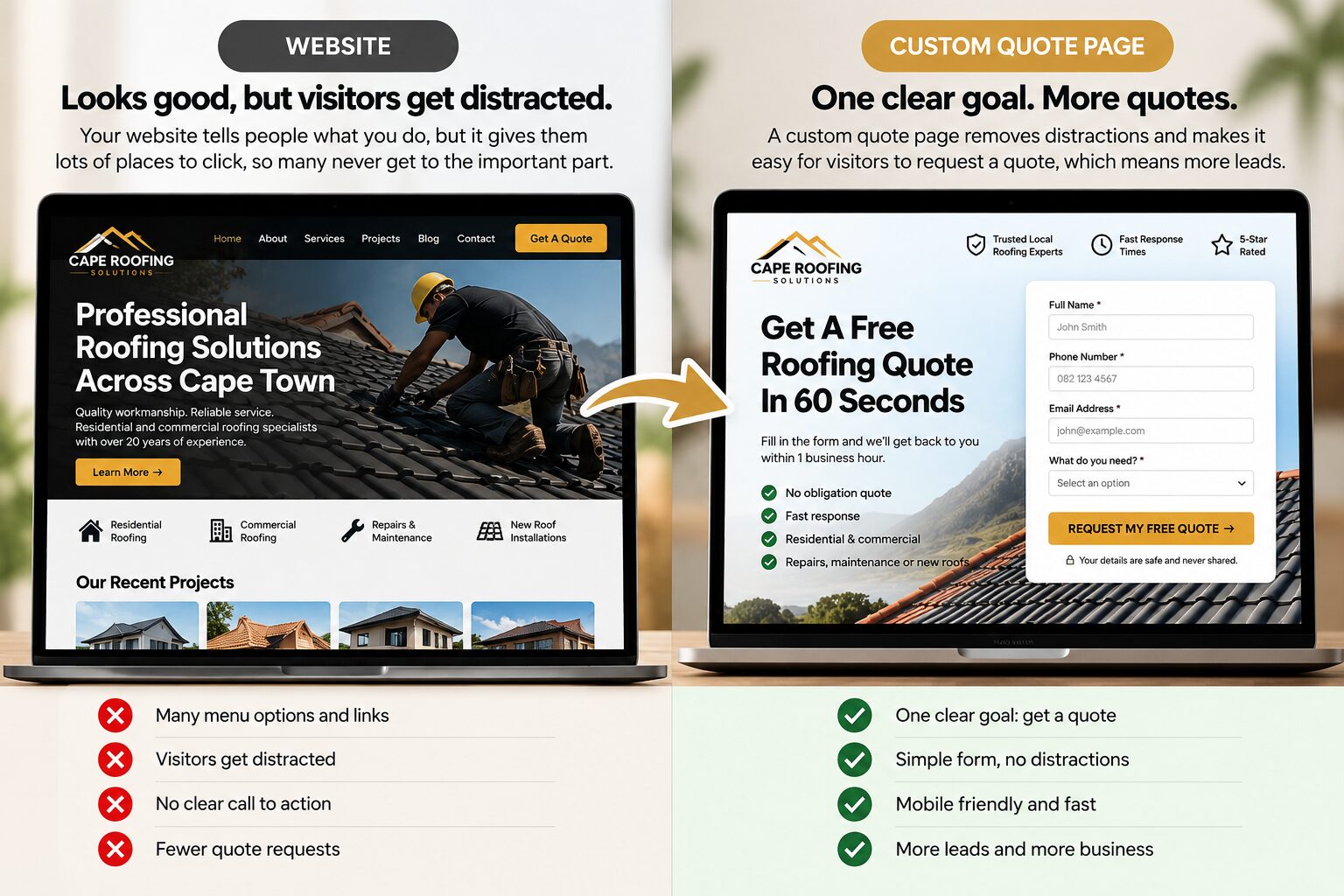
A separate, custom quote page gives interested visitors a clearer path to request a quote.
When you connect that with the right advertising, follow-up and lead management, you give yourself a better opportunity to turn interest into paying customers.
Looking for a Lead Generation Agency?
Answer a few quick questions about your business, and we’ll assess how we can help you generate more enquiries with a custom quote page and a lead generation system built around your business.
The Benefits of Having a Website for Your Business
Let’s start with why having a website is important in the first place.
1. Your Website Builds Trust and Credibility
Imagine a potential customer has been given your business name by a friend. They search for you on Google, but there’s no website.
They might wonder whether you’re still operating, whether you’re established or whether they should choose a competitor they can find more information about.
A professional website helps answer those questions.
It gives people somewhere to learn about your business, understand your services, see examples of your work and find your contact details. Testimonials, case studies, photographs and clear service descriptions can all help build confidence.
Your website doesn’t need to be complicated to do this well. It needs to look professional, explain what you do and make it easy for potential customers to understand why they should consider your business.
2. Your Website Helps Customers Find You on Google
When people need a service, many turn to Google to research their options.
A well-structured website gives search engines useful information about your business, the services you provide and the areas you serve.
With a suitable SEO strategy, your website can help you appear for searches relevant to your services. Helpful content can also answer customer questions before they contact you.
For example, people might want to understand the process, compare options, check what a service includes or learn what to consider before requesting a quote.
Your website gives you somewhere to answer those questions and build visibility over time.
The important distinction: SEO helps people discover your business. Your website then needs to help them take the next step.
Being found on Google is valuable, but visibility alone doesn’t guarantee enquiries.
3. You Can Educate Customers Before They Contact You
Not every potential customer is ready to request a quote immediately.
Some need to understand your services first. Others want to know how your process works, what is included, what makes your business different or whether you have experience with a particular type of job.
Your website gives you space to explain these things.
You can include service pages, frequently asked questions, project examples, testimonials and useful articles that address the concerns customers have before making a decision.
This can help people arrive at a conversation with a better understanding of your business.
It also means you don’t have to explain every basic detail from scratch whenever someone contacts you.
4. Your Website Works Around the Clock
Your business may close for the evening, but your website remains available.
Potential customers can research your services outside your working hours, look at your previous work and find out how to contact you.
This is especially useful when you’re busy delivering the service itself. You may not be available to answer every call or message immediately, but your website can still provide the information customers need.
However, there is an important limitation.
A website can provide information 24/7, but that doesn’t automatically mean it will generate enquiries 24/7.
If visitors cannot quickly understand what to do next, or if the enquiry process is confusing, they may leave without contacting you.
That’s where the design of your customer journey matters.
5. Your Website Supports Your Other Marketing
Your website gives your marketing a central place to direct people.
You can link to it from your social media profiles, email campaigns, Google Business Profile and online advertising. You can also use it to publish helpful content and demonstrate your expertise.
Without a suitable destination, your marketing has fewer opportunities to turn attention into meaningful action.
But that brings us to an important question.
When someone clicks through to your website, are you making it as easy as possible for them to enquire?
The Downsides of Relying on Your Website to Generate Every Enquiry
Websites are valuable, but they are often expected to do too many jobs at once.
They need to explain the business, introduce services, support SEO, showcase work, answer questions, provide contact details and help visitors decide what to do next.
Those functions matter. The problem arises when a visitor who is ready to request a quote has to navigate through all that information to find the next step.
Let’s look at what can go wrong.
1. Too Many Choices Can Distract Potential Customers
Think about a typical business website.
It may have a homepage, several service pages, an about page, a portfolio, a blog, testimonials, a contact page, a menu, links to social media and multiple calls to action.
All of these elements can serve a purpose.
But when someone arrives specifically because they want a quote, they may not need to explore the entire website. They need to understand whether you can help them and how to get in touch.
If the next step isn’t obvious, they may click around, become distracted or leave.
This is particularly important when you’re paying for advertising. Every visitor represents an opportunity, but not every visitor will take the time to navigate a complicated journey.
The goal isn’t to remove useful information from your website. It’s to give people a more direct route to enquire when they’re ready.
2. A Website Can Be Slow, but More Pages Aren’t Automatically the Problem
A slow website can frustrate visitors and cause them to leave before they have properly explored your services.
Large images, poorly optimised code, excessive scripts, unreliable hosting and other performance issues can all affect loading speed.
However, having lots of pages doesn’t automatically make a website slow. A well-built website can have many pages and still perform well.
The bigger issue is that a website can be technically fast and still make it unnecessarily difficult for someone to request a quote.
Speed matters. So does clarity.
You need a website that loads efficiently and a customer journey that makes sense.
3. Visitors Can Enter and Leave at Different Points
Here’s something worth thinking about.
A visitor doesn’t always enter your website through the homepage.
They might arrive through a specific service page from Google, a blog article, a link from social media or a paid advert.
They may then leave from that same page without visiting anything else.
That isn’t necessarily a problem. They may have found exactly what they needed.
But if visitors regularly leave without enquiring, you need to understand why.
Are they finding the right information? Can they see what to do next? Is the contact process easy? Are they arriving on a page that matches what the advert promised?
Without analytics and conversion tracking, you may not have enough information to answer these questions confidently.
You shouldn’t have to guess where your potential customers are getting stuck.
Tracking helps you understand how people move through your website, which pages generate enquiries and where opportunities may be slipping away.
4. Your Contact Page May Be Asking Too Much of the Lead
Imagine someone has clicked an advert because they need a quote.
They land on your website, browse through your services and eventually find the contact page. There, they may need to work out which department to contact, find the right email address, decide what information to include and wait for a response.
Some people will follow through. Others won’t.
The more effort you ask someone to make, the more opportunities you create for them to abandon the process.
This doesn’t mean every contact form needs to be short or that you should never ask questions. You may need specific information to provide an accurate quote.
The key is to ask for the right information in a clear, logical order and explain what happens after the form is submitted.
5. Paid Advertising: Sending People to the Wrong Place
Suppose you’re paying for Google Ads to attract people searching for one of your services.
Someone clicks your advert because they have a specific need. Instead of arriving at a page focused on that service and the next step, they land on your general homepage.
Now they need to work out where to go.
They may find the right service page and enquire. They may also explore other pages, get distracted or leave.
Your homepage might be excellent at introducing your business, but that doesn’t automatically make it the best destination for every advertising campaign.
The destination should match the customer’s intention.
If someone is ready to request a quote, give them a straightforward way to do so.
The Leaky Bucket Problem: Why Website Visitors Don’t Always Become Leads
Imagine filling a bucket with water.
The water represents the money you’re spending to attract potential customers through Google Ads and other marketing channels.
The bucket represents your website and the process that turns visitors into enquiries.
If the bucket has holes, some of the water escapes before it can fill the bucket.
That’s what can happen when you invest in marketing but make it difficult for potential customers to take the next step.
You might be getting clicks. People might be visiting your website. Some might even be interested in your services.
But if the journey from interest to enquiry is confusing, you can lose opportunities before they become leads.

The answer isn’t automatically to spend more money on advertising.
Before increasing your budget, look at what happens after someone clicks.
- Does the page match what the person was searching for?
- Is the service explained clearly?
- Can the visitor see why they should trust your business?
- Is the next step obvious?
- Can they request a quote without unnecessary effort?
- Does someone follow up promptly when an enquiry comes in?
- Are you tracking how many visitors become actual enquiries?
These questions help you identify whether the problem is a lack of traffic, a weak conversion process or a combination of both.
Want to See What This Looks Like in Practice?
We have worked with businesses to connect their marketing with a clearer path from interest to enquiry.
Rather than relying on clicks alone, the aim is to create a process that helps attract potential customers, encourage them to enquire and manage those enquiries more effectively.
Explore our lead generation case studies to see examples of the results businesses have achieved.
What Is a Custom Quote Page?
A custom quote page is a dedicated web page built around a specific service and a clear objective: encouraging the right potential customers to request a quote.
It is designed to work alongside your main website, not replace it.
Unlike a traditional website, which needs to serve several purposes, a custom quote page focuses on the journey from interest to enquiry.
It can explain the service, address common concerns, show relevant proof and guide the visitor towards one clear next step.
For example, instead of asking a potential customer to navigate through your homepage, service pages and contact page, you can direct them to a page specifically designed for the service they’re interested in.
The page can include the information they need to make a decision without requiring them to explore your entire website first.
Your Website and Your Quote Page Have Different Jobs
This is the distinction that matters.
Your main website educates. Your custom quote page focuses on generating enquiries.
Your website helps visitors learn about your company, explore your services, understand your experience and find answers to their questions.
Your custom quote page takes a more focused approach. It helps someone who is interested in a particular service understand the next step and request a quote.
Both are valuable, and both can support your marketing.
| Your main website | Your custom quote page |
|---|---|
| Introduces your business | Focuses on a specific service or offer |
| Helps customers explore your services | Guides interested visitors towards an enquiry |
| Supports SEO and educational content | Supports conversion from targeted traffic |
| Provides several routes through your content | Keeps the next step clear and focused |
| Builds a broader understanding of your business | Helps turn specific interest into a quote request |
A quote page doesn’t need to contain every detail from your main website. It needs the right information to help the visitor decide whether to enquire.
And it should never be a compromise on trust, quality or useful information. A focused page still needs to answer the customer’s important questions.
Get a Custom Booking Page for Your Business
Make it easier for potential customers to take the next step. Get a dedicated booking page designed around your business, helping turn interested visitors into bookings and enquiries.
A Custom Quote Page Does Not Replace Your Website
Let’s make this clear because it is an important distinction.
Your custom quote page is not another tab on your website called “Get a Quote”. It is a separate page with its own URL, built for a specific conversion goal.
Your main website continues to do its job. It educates visitors, showcases your business, supports your SEO strategy and provides a home for your wider content.
Your custom quote page sits separately and can be used as a dedicated destination for relevant marketing campaigns.
For example, you might send someone who is searching for a particular service directly to a quote page designed around that service. Someone who wants to learn more about your business can still visit your main website.
This gives you two complementary tools instead of expecting one website journey to do everything.
What Should a Good Custom Quote Page Include?
A custom quote page should be designed around what your potential customer needs to know before enquiring.
1. A clear headline
Tell visitors what the page is about and what they can do next. They should not have to guess whether they have arrived at the right place.
2. A clear explanation of the service
Explain what you offer, who it is for and what the customer can expect. Keep the information relevant to the service the visitor came to learn about.
3. Reasons to trust your business
Include genuine testimonials, relevant project examples, qualifications, experience or other evidence that helps customers feel confident. Don’t make claims you cannot support.
4. A straightforward enquiry form
Ask for the information you genuinely need to start the conversation or prepare a quote. Avoid unnecessary questions that make the process feel like hard work.
5. One clear next step
Make it obvious how the customer should proceed. Use clear wording such as “Request a Quote” or another action that accurately reflects what happens next.
6. A good mobile experience
Many people browse and enquire from their phones. The page should load efficiently, display clearly on smaller screens and make the form easy to complete.
7. Proper tracking
Track meaningful actions, including completed enquiry forms and other relevant conversions. This helps you understand whether your marketing is generating enquiries, rather than judging performance by clicks alone.
The exact design will depend on your business, service and audience. A page that works well for one business may need a different approach for another.
See the Difference for Yourself
The best way to understand the difference between an educational website and a focused quote page is to look at real examples.
Our case studies show how lead generation strategies can connect advertising, dedicated pages and follow-up to help businesses generate and manage enquiries.
Browse our case studies and look at how the customer journey changes when the focus moves from simply attracting attention to helping people take action.
Quote Pages, Booking Pages and Consultation Pages: Which Do You Need?
You may hear businesses use terms such as quote page, booking page and consultation page. They are related, but they serve different purposes.
The right option depends on what you want the customer to do.
Quote Pages
A quote page is useful when a customer needs to explain what they want before you can provide a price or recommendation.
The page encourages the visitor to submit their details and relevant information about the work required.
The objective is to generate a quote request that your team can assess and follow up.
Booking Pages
A booking page is designed to help someone select an available time or schedule an appointment directly.
This is useful when the next step is a scheduled service, appointment or meeting and your business has a process for managing availability.
Consultation Pages
A consultation page encourages potential customers to arrange a conversation before making a decision.
It is useful when the service requires a discussion about the customer’s needs, options or circumstances before the work can proceed.
The important thing is to match the page to the action you want the visitor to take. Don’t ask someone to book a consultation if what they really need is a quote, and don’t make them complete a long quote form if a straightforward appointment is the right next step.
You can see examples of how these approaches fit into broader lead generation strategies in our case studies.
A Quote Page Is Only One Part of the Solution
A dedicated quote page can make the journey from interest to enquiry clearer. But it cannot fix every problem in your lead generation process on its own.
You still need to attract the right people, give them a relevant reason to enquire and make sure their enquiries are handled properly.
Consider what happens after a potential customer submits a form.
Does the enquiry reach the right person? Does someone respond promptly? Is there a clear process for following up if the customer doesn’t answer? Can you see which enquiries came from your marketing? Do you know which leads turned into paying customers?
If these steps are disconnected, you can still lose opportunities even when your quote page is working well.
This is why it’s worth looking at your lead generation as a complete process rather than a collection of separate marketing activities.
What a Connected Lead Generation System Can Do
A connected system can bring together the key steps involved in attracting and converting potential customers.
Depending on your business and requirements, this may include:
- Google Ads: Reach people actively searching for relevant services.
- A dedicated quote page: Give interested visitors a focused route to request a quote.
- Enquiry tracking: Record where leads come from and what happens after they enquire.
- Automated follow-up: Help ensure potential customers receive timely communication.
- Lead management: Keep enquiries organised so your team can respond and follow through.
- Reporting: Understand which activities are generating enquiries and contributing to business results.
The objective isn’t to add technology for the sake of it. It’s to make the process easier to manage and help reduce the number of opportunities that fall through the cracks.
Want a Lead Generation System That Connects the Dots?
Are You Paying for Website Visitors Who Never Enquire?
Your website might look great, but is your marketing turning visitors into quote requests and paying customers?
Complete our short client quiz before your lead generation assessment. Your answers will help us understand your business, services, current marketing and goals before we speak, so we can focus on your actual challenges rather than spend the call collecting basic information.
Complete the Quiz and Book Your Lead Generation Assessment →
If you’re looking at your marketing and wondering why more of your website visitors aren’t becoming customers, it may be time to look at the complete process.
Our lead generation packages are designed to help businesses move beyond disconnected marketing activities and build a more joined-up approach to attracting and converting leads.
You can also explore our lead generation tools to see how the right tools can support enquiry management, follow-up and the wider customer journey.
The right solution depends on where your current process is losing opportunities. Sometimes the issue is attracting the right traffic. Sometimes the website journey needs work. Sometimes enquiries are coming in but aren’t being followed up effectively.
The first step is understanding where the gaps are.
How to Get More Value From Your Website
You don’t need to throw away your existing website or rebuild everything from scratch to improve your results.
Start by looking at how your website supports your business and where potential customers may be struggling to take the next step.
Review Your Most Important Service Pages
Look at the pages people are most likely to visit when researching your services.
Can they quickly understand what you offer? Is the information relevant to their needs? Is there a clear way to enquire? Does the page answer the questions someone would reasonably have before contacting you?
Don’t assume a page is performing well simply because it looks attractive. Look at how it supports the customer’s journey.
Check Your Website Performance
Test how quickly your website loads, particularly on mobile devices.
Large images, unnecessary scripts and technical issues can affect performance. Address problems that are slowing the experience down, and make sure the site is easy to use on different screen sizes.
A faster, clearer website can improve the experience for both visitors and search engines.
Make Your Calls to Action Clear
A call to action tells the visitor what to do next.
Depending on the page, this might be to request a quote, contact your team, arrange a consultation or explore a service.
Use clear, relevant wording and place the next step where people can find it. Avoid making visitors hunt for contact details or work out how to proceed.
Track Enquiries, Not Just Traffic
Website traffic is useful information, but it doesn’t tell you the full story.
Track how many enquiries you receive, where they originate and which ones turn into paying customers where possible.
This helps you assess the value of your marketing and identify areas that need attention.
If a campaign brings in plenty of visitors but very few enquiries, investigate the page and the traffic quality before assuming you simply need a larger advertising budget.
Keep Your Content Useful and Up to Date
Your website should reflect your current services, business information and experience.
Helpful articles and clear service pages can support SEO and answer the questions potential customers ask. Review outdated information, broken links and content that no longer reflects what you offer.
Your website should be a useful resource, not simply an online brochure that never changes.
Build a Clear Route From Interest to Enquiry
Finally, consider whether some visitors would benefit from a more focused route to request a quote.
Your main website can continue to educate and build trust, while a dedicated quote page can support campaigns aimed at people who are ready to take action.
The aim is to make the next step easier without removing the information customers need to make an informed decision.
Frequently Asked Questions
Is having a website still important for a small business?
Yes. A website can help establish credibility, explain your services, support your visibility on Google and give potential customers a place to research your business. The important thing is to make sure it supports your business goals and provides a clear route for interested visitors to contact you.
Can a website generate leads on its own?
A website can generate enquiries, especially when supported by relevant traffic, useful content and clear calls to action. However, having a website does not guarantee a steady flow of leads. The results depend on factors such as your audience, services, visibility, page experience and follow-up process.
What is the difference between a website and a custom quote page?
A website generally provides broader information about your business and services. A custom quote page is a separate page with its own URL, designed around a specific service and a clear objective, such as encouraging a visitor to request a quote. They work alongside each other rather than replacing one another.
Does a custom quote page replace my existing website?
No. Your main website remains important for educating customers, showcasing your experience, supporting SEO and providing information about your business. A custom quote page provides a more focused route for visitors who are ready to enquire.
Should I send Google Ads traffic to my homepage?
Not necessarily. The best destination depends on what the person searched for and what the advert promises. A homepage may be appropriate for some campaigns, but a relevant service page or dedicated quote page may provide a clearer journey for someone who is ready to enquire.
How do I know if my website is losing leads?
Look at your website analytics, enquiry numbers and conversion tracking. Check where visitors arrive, what they do next and whether they complete the desired action. If traffic is coming in but enquiries remain low, review the relevance of the traffic, the page content, the clarity of your calls to action and the ease of the enquiry process.
Do I need a new website to get more leads?
Not always. Your existing website may only need improvements to its content, performance, calls to action or enquiry process. In some cases, a dedicated quote page or a more connected lead generation system may be a better starting point than a complete website rebuild. The right approach depends on the problems you identify.
What should I look for in a lead generation package?
Look for an approach that considers the whole journey, not just the number of clicks or website visitors. Depending on your needs, that could include targeted advertising, relevant quote pages, enquiry tracking, follow-up and reporting. Make sure you understand what is included, how performance will be measured and how leads will be managed.
Let’s Find the Gaps in Your Lead Generation
Your website is an important part of your business. It helps people discover you, learn about your services and decide whether they can trust you.
But if you want more enquiries, it’s worth looking beyond the website itself.
Are you attracting the right people? Are you giving them a clear route to request a quote? Are enquiries being followed up? Can you see which parts of your marketing are contributing to paying customers?
When these steps work together, your marketing has a clearer path from attracting attention to generating business.
Let’s Find Out What’s Holding Your Lead Generation Back
More traffic isn’t always the answer. You may need a clearer quote-request journey, better follow-up or a more connected system.
Complete our client quiz before your lead generation assessment. It gives us useful background on your business, services, current marketing and goals, so we can make better use of our time together.
Book your lead generation assessment and let’s look at how your website, quote pages and lead follow-up can work together to help your business generate more opportunities.