

Agent Sprawl Is Real: How to Tame Your AI Agent Chaos
If you only read one part of this: agent chaos doesn’t arrive as a decision, it arrives one reasonable “I just need one more agent” at a time.
Five steps fix it: inventory every agent you’re actually running, assess what’s worth keeping, consolidate the overlaps, centralise the survivors under one dashboard, and monitor so nothing fails silently again. Gartner expects the average Fortune 500 company to run over 150,000 agents by 2028, up from fewer than 15 in 2025.
The chaos is coming for everyone. The only question is whether you get ahead of it.
You started with one agent.
It summarised your inbox and it worked, so you built another for research.
→ Then one for drafting content.
→ Then a quick cron job to check your logs.
Six months later you have a dozen agents running across four platforms, and you couldn’t name half of them if someone put a gun to your head.
That’s agent chaos, and if you’re reading this, you probably already have it.
It’s the same story that played out with SaaS tools a decade ago.
Okta and Blissfully studies found the average enterprise runs more than 200 SaaS subscriptions, most of them adopted quietly by individual teams with no central oversight.
Agents are following the exact same curve, except they move faster and they can act on their own.
Here’s the uncomfortable part. This is worse than tool sprawl, because a forgotten SaaS subscription just sits there costing you money.
A forgotten agent:
→ keeps running
→ keeps making decisions
→ keeps burning tokens
And can fail without anyone noticing for days.
Let’s fix that.
The Agent Sprawl Audit
Agent chaos: tools scattered across different platforms
Sprawl never arrives as a decision. It arrives one reasonable “I just need one more agent for this specific task” at a time.
Want to try it yourself? Agent Console is free and open source. Download it on GitHub and have your first agent dashboard running in about ten minutes.
The accumulation curve is predictable.
One agent becomes three because three narrow agents feel cleaner than one that does everything.
Three become six when you add monitoring and a couple of scheduled jobs.
Six become twelve when you spin up experiments and never turn them off.
Nobody ever sat down and chose to run twelve agents. It just happened.
The problem is that you crossed a threshold somewhere in there without noticing. Below it, you hold the whole system in your head. Above it, you don’t, and things start slipping through cracks you cannot see.
Here are the signs you’re already past the line:
| Warning Sign | What It Looks Like |
|---|---|
| You cannot list all your agents from memory | If you have to go digging through config files to remember what’s running, the system is running you. |
| Two agents do roughly the same thing | You built a second research agent because you forgot the first one existed, or because finding it was harder than rebuilding it. |
| You discovered an agent running that you’d completely forgotten about | Bonus points if it had been running for weeks. |
| You don’t know which agent owns which task | When something needs doing, you hesitate, because you’re not sure who’s responsible. |
| An agent failed and you found out days later | No alert, no error surfaced anywhere you look, just a silent gap in the work. |
If two or more of those landed, you don’t have a tooling problem. You have a coordination problem, and no amount of adding more agents will solve it.
Worth knowing: you’re not alone, and it’s not a sign you did something wrong. Gartner projects that by 2027, 75% of employees will acquire, modify, or create technology without IT oversight, up from 41% in 2022.
Agent chaos is the default outcome of giving people easy tools, not a personal failure.
The Hidden Costs of Agent Chaos
The reason this is easy to ignore is that none of its costs show up as a single big number. They leak out in small amounts across your whole operation.
| Hidden Cost | What It Actually Costs You |
|---|---|
| Coordination tax | Every switch between agents costs a small mental toll, which interface, which login, which prompt style. Multiply by a dozen agents and a dozen switches a day. |
| Context loss | Information gets trapped inside one agent’s memory. You become the human courier carrying facts between machines that should be talking to each other. |
| Duplicate work | Two agents research the same topic because neither knows the other did it. You pay twice in tokens and get two slightly different answers to reconcile. |
| Blind spots | The dangerous one. Agents fail silently, a cron job stops firing, an API key expires, and nothing surfaces it until the failure causes a visible problem downstream. |
| Token waste | Redundant work isn’t free. Every duplicated research pass and uncapped retry loop is money out the door. |
| Decision fatigue | The smallest cost, and the most constant. “Which agent do I ask?” is a question you shouldn’t have to answer fifty times a day. |
None of these will bankrupt you on their own. Together they turn a system that was supposed to save you time into one that quietly eats it.
Want to try it yourself? Agent Console is free and open source. Download it on GitHub and have your first agent dashboard running in about ten minutes.
The Sprawl Triage Framework
The fix isn’t clever. It’s just disciplined. Five steps, in order, and you don’t skip ahead.
| Step | What You Actually Do |
|---|---|
| 1. Inventory | List every single agent you’re running, not just the ones you remember. For each, note where it lives, what it does, and how it’s triggered. Most people are genuinely surprised by their own list. |
| 2. Assess | Rate each agent honestly: how often is it actually used, how well does it work, and could something else already do this job? An agent you built with pride six months ago isn’t sacred. |
| 3. Consolidate | Merge agents that overlap. Kill agents nobody uses. This is where the list gets shorter, and shorter is the goal. |
| 4. Centralise | Put every surviving agent under one dashboard, one place to see all of them, their status, and what they’re working on. |
| 5. Monitor | Add health checks so nothing fails silently again. Every agent needs a heartbeat, and any agent that goes quiet should generate an alert you’ll actually see. |
Run those five steps once and you go from a pile of agents to a system. Run them quarterly and you stay there.
The balance worth striking: some companies respond to agent chaos by locking everything down so hard nobody can build anything useful. That’s not the answer either. The goal is governed experimentation, not zero experimentation. Sandbox agents can stay loose.
Production agents need owners, logs, permissions and a clear retirement rule.
Consolidation Strategies That Actually Work
Step three, consolidate, is where people get stuck, because deleting your own work feels bad. Here are the patterns that make it concrete.
| Strategy | What It Means |
|---|---|
| Merge by function | Two agents doing similar jobs become one agent with a better prompt. Your “find sources” agent and your “summarise sources” agent were never two jobs, they were one job split because it was easier to build in pieces. |
| Merge by workflow | Chain agents that always run in sequence into a single pipeline. A research agent feeding a writing agent |
That last one is the quiet multiplier. Consolidation removes waste. Shared memory adds compounding value, because knowledge stops dying inside a single agent’s context window.
Case Study: From 12 Agents to 6
This isn’t hypothetical. It’s roughly the path our own operation took, back when nobody could say with confidence what was actually running at any given moment.
| Before | After |
|---|---|
| Twelve agents across four platforms, three different cron systems, no central monitoring | Six focused agents, each with a clear job |
| Nobody could say with confidence what was running at any given moment | One screen to see all of them on |
| Four duplicate capabilities doing nearly identical work | One shared knowledge base every agent reads and writes to |
| Two dead agents still technically running, producing nothing anyone read | Health checks watching every single one |
The audit surfaced the duplicates and the dead weight. The four duplicates collapsed into two stronger agents. The two dead ones were killed outright. Three more genuine but foldable agents merged into adjacent roles.
Results:
- Coordination time dropped by roughly 40%, almost entirely because “which agent, where, doing what” stopped being a daily question
- Silent failures went to zero, not because the agents stopped failing, but because failures now surface immediately instead of hiding for days
Twelve to six wasn’t about doing less. The six agents do more than the twelve did. It was about removing the overhead the extra six were quietly imposing.
The scale this is heading toward: Gartner projects the average Fortune 500 enterprise will run over 150,000 AI agents by 2028, up from fewer than 15 in 2025. If six agents can generate this much disorder without a system, imagine what a hundred does. The fix doesn’t get harder at scale. It gets more necessary.
The Anti-Sprawl Toolkit
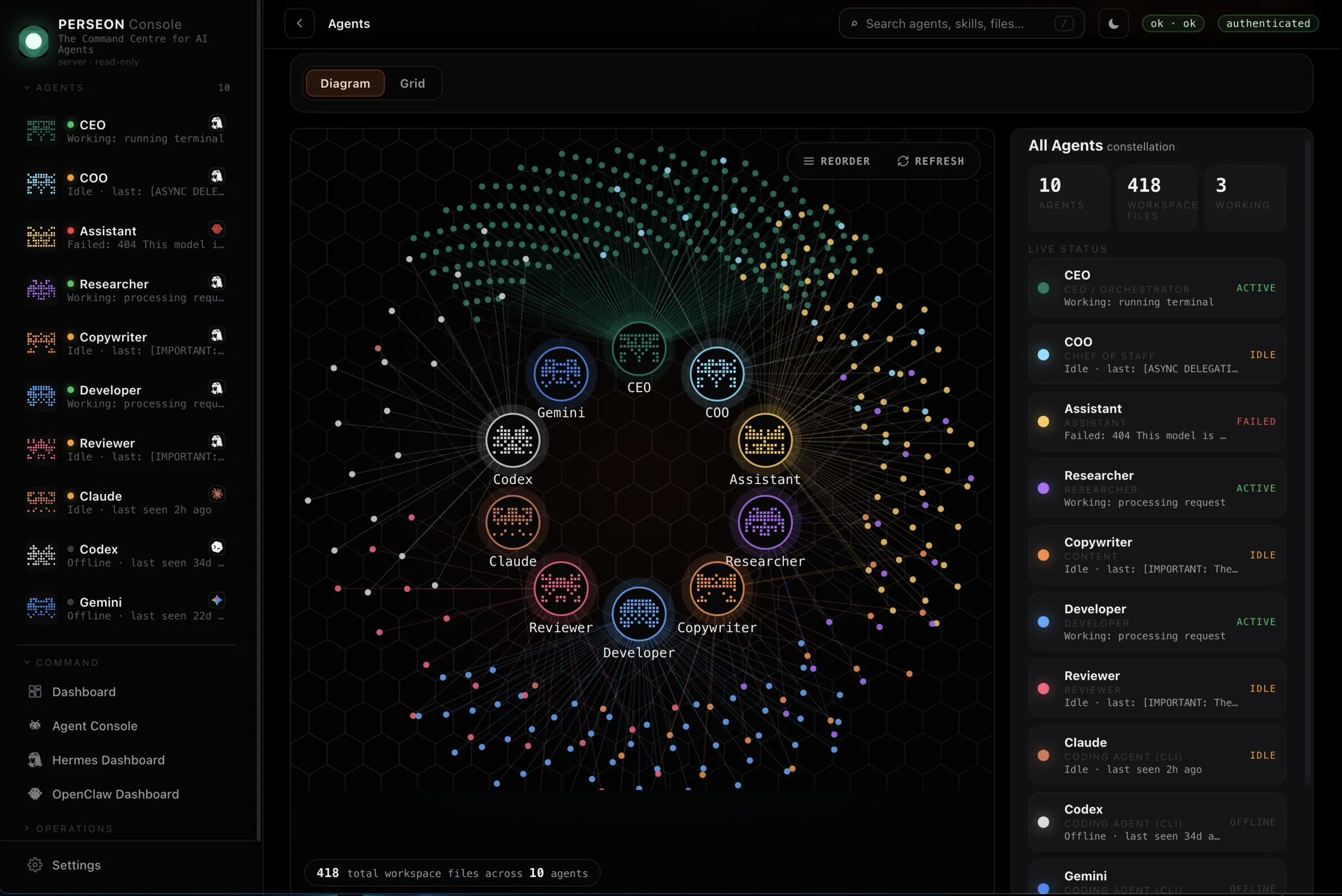
Consolidation only sticks if you have somewhere for the survivors to live. This is exactly what we built Perseon Console to be, after living the twelve-agent version of this ourselves.
| Feature | What It Solves |
|---|---|
| One dashboard for every agent | All your agents on a single screen with live status, and the perfect starting point for your own sprawl audit |
| Kanban for clear ownership | Every task has a visible owner and a lane, retiring “I thought the other agent was handling that” for good |
| A shared Brain | Agents write findings into a common knowledge base instead of hoarding them in isolated memory |
| Built-in health checks | Every agent gets monitored, so a failure surfaces the moment it happens instead of days later |
| Escalation paths | A stuck agent doesn’t spin forever burning tokens, it escalates, turning a jam into a notification instead of a runaway bill |
None of these are exotic. They’re just the discipline of the triage framework, baked into one place so you don’t have to hold the whole system in your head anymore.
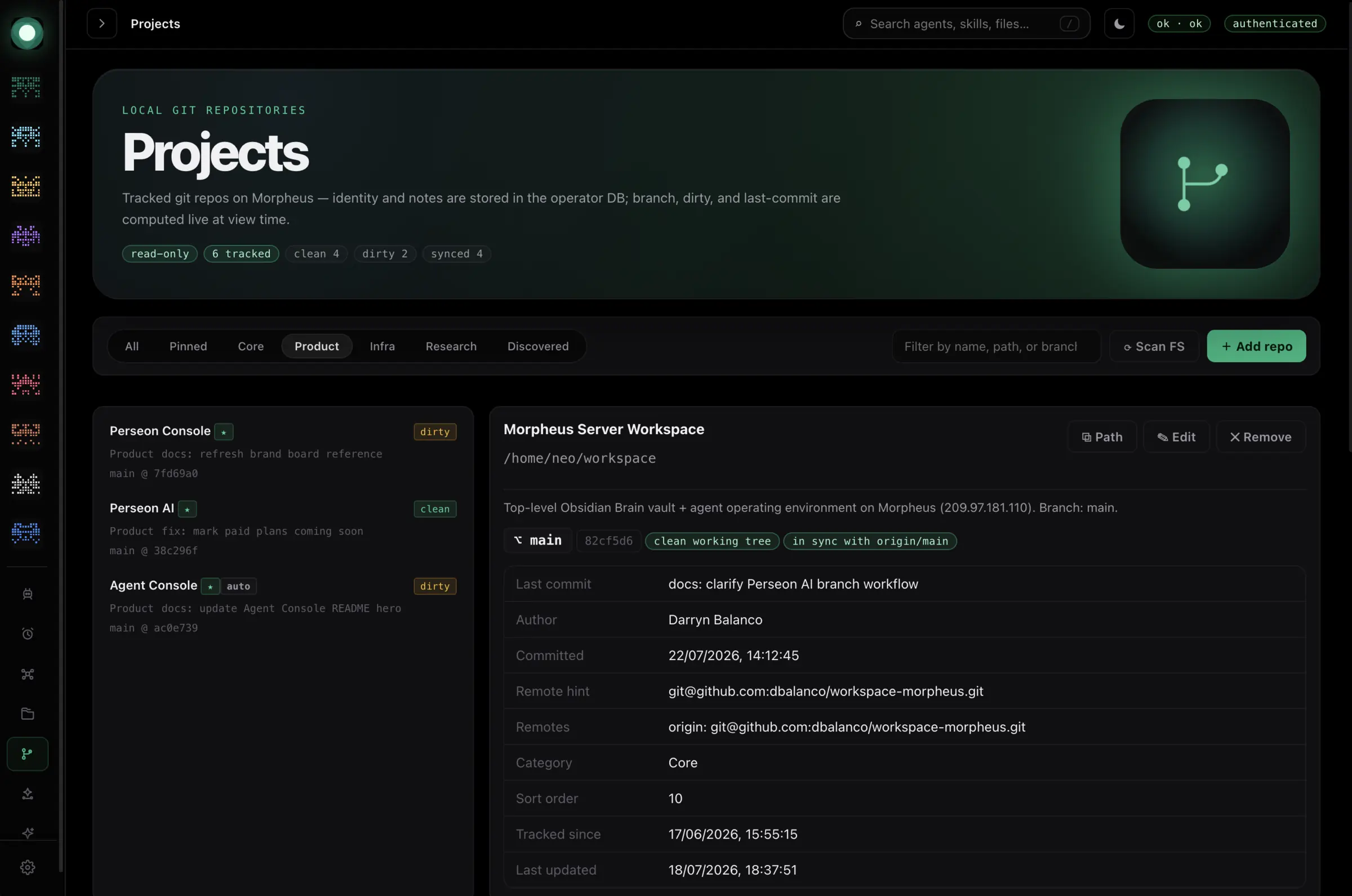
The same project view, this is what the far side of agent chaos actually looks like
Want to try it yourself? Agent Console is free and open source. Download it on GitHub and have your first agent dashboard running in about ten minutes.
Run Your Own Audit
Here’s your homework, and it takes about twenty minutes.
Open a blank document. Write down every agent you’re running. For each one, note where it lives, what it does, and how often you actually use it. When the list is done, look for the duplicates, the zombies, and the ones you’d forgotten existed. That’s your agent chaos, staring back at you in black and white.
Then start cutting. Merge the overlaps. Kill the zombies. Pull the survivors onto one screen.
You don’t need permission and you don’t need a bigger budget. You need one honest inventory and the willingness to turn things off. The agents that survive will do more, cost less, and stop failing in the dark.
Run the sprawl audit on your agents.
Then bring the survivors into Perseon Console and see all of them in one place.
Get Started: Two Ways Out of Agent Chaos
Wherever you are in the sprawl fight, there’s a starting point that fits.
| Option | Best For | What You Get |
|---|---|---|
| Agent Console (free) | Seeing your agents on one screen tonight | A lightweight single-page dashboard you run locally. Turns “I think I have a dozen agents” into an actual list in about a minute. |
| Perseon Console (paid) | The full mission control setup | Kanban ownership, a shared Brain, health checks and escalation paths, all in one place, running as a proper suite instead of something you hold together in your head. |
Start free, and upgrade when the survivors of your audit deserve a real home.
Once you’ve consolidated your fleet, our guide to mission control for AI agents shows you how to run them from one screen.
For the day-to-day coordination principles, see our post on managing multiple AI agents.
Frequently Asked Questions
What is AI agent sprawl?
AI agent sprawl is when you accumulate too many disconnected AI agents without proper management. You end up with agents running in different places, doing overlapping work, failing silently, and nobody knows what’s running or who owns what.
How do I know if I have agent chaos?
You have it if you cannot list all your agents from memory, if two agents do similar things, if you’ve found agents running that you’d forgotten about, or if agents fail and you find out days later.
How do I fix AI agent chaos?
Run a sprawl audit. Inventory all your agents, assess each one’s value, consolidate the duplicates, kill the unused ones, and bring the survivors under one dashboard like Perseon Console. Then add monitoring so nothing fails silently.
How many AI agents is too many?
It’s not about the number, it’s about whether you can manage them. If you can see all your agents on one screen, each has a clear owner, and you know when something fails, you can run more than ten. If not, even three is too many.
What’s the difference between agent sprawl and tool sprawl?
Tool sprawl is too many SaaS subscriptions. Agent sprawl is too many self-running AI processes operating without coordination. Agent chaos is worse, because agents can fail silently, duplicate work, and waste compute resources without you ever knowing.
What is “shadow AI” and how does it relate to agent chaos?
Shadow AI is the use of unauthorised AI tools or agents employees spin up without formal IT approval. It’s a close cousin of agent chaos, not quite the same thing, since even sanctioned, approved agents contribute to sprawl if they’re deployed without coordination. But ungoverned sprawl makes shadow AI more likely, since people build their own workarounds when the official system feels unmanageable.
How many AI agents will companies actually be running in the next few years?
Gartner projects the average Fortune 500 enterprise will run over 150,000 AI agents by 2028, up from fewer than 15 in 2025. Whatever this looks like at your current scale, it’s a preview of a much bigger problem industry-wide.
What’s the difference between identity sprawl and context sprawl?
Identity sprawl is too many agents existing across an organisation, many undiscovered or over-permissioned, with no lifecycle management. Context sprawl is each agent building its own isolated understanding of the business, which causes conflicting answers to the same question. Most governance conversations only address the first one.
Is agent chaos a security risk, not just an efficiency problem?
Yes. Agents are often over-permissioned, granted far more access than their actual task requires, and unlike a SaaS tool, an agent is both the application and the user. An ungoverned agent can inherit permissions and move across systems in ways that create real exposure, not just wasted time.
Should I stop employees from building their own agents to prevent sprawl?
Locking everything down tends to backfire, it turns a fast, useful innovation habit into another approval queue, and pushes people toward shadow AI instead. The better balance is governed experimentation, sandbox agents can stay loose, but anything running in production needs an owner, logs, and a retirement rule.
What’s the very first step in fixing agent chaos?
Inventory, before anything else. You cannot consolidate, centralise, or monitor agents you haven’t actually listed. Most people are surprised by what turns up once they write down every agent they’re actually running, not just the ones they remember.
Do I need an enterprise governance framework to fix agent chaos, or can I do it myself?
For a small fleet, no. The five-step triage framework in this guide is something one person can run in an afternoon. Formal governance frameworks matter more at the scale Gartner is describing, hundreds or thousands of agents across departments, but the underlying discipline, inventory, assess, consolidate, centralise, monitor, is the same at any scale.
A Final Word on Agent Sprawl
Agent chaos isn’t a sign you did something wrong. It’s the predictable result of a tool that makes it too easy to say yes to “just one more agent.”
The fix isn’t cleverness, and it isn’t a bigger budget. It’s twenty honest minutes with a blank document, the willingness to turn things off, and one screen where the survivors actually live.
Do that once, and agent chaos stops being something that happens to you.
Want to try it yourself? Agent Console is free and open source. Download it on GitHub and have your first agent dashboard running in about ten minutes.