

How To Generate Solar Leads
There are plenty of solar leads. Most installers just aren’t set up to capture them.
Every month, homeowners, farms, schools and factories within driving distance of your workshop search Google for a solar installer.
Most of them will never speak to you.
Not because your solar systems are worse.
Because somebody else captured the enquiry first.
This guide shows you where solar leads actually come from, what a solar lead should be worth to your business, the ten steps that turn solar searches into booked site visits, and how to tell whether you have a solar leads problem or a follow-up problem.
Why We Don’t Rely on Your Main Website to Generate Solar Leads
Your website might be costing you valuable solar enquiries. Discover a better way to turn interest into quote requests.
It covers the South Africa, UK and US solar markets, with practical guidance you can adapt to your local service area.
The demand for solar has never been stronger, and the opportunity to generate solar leads has never been bigger, especially as electricity prices and energy concerns continue to influence buying decisions.
In South Africa 🇿🇦 electricity costs and concerns about grid reliability continue to push homeowners and businesses towards greater energy independence.
In the UK 🇬🇧 energy costs and long-term energy planning can influence demand for solar installations. In
the USA 🇺🇸 homeowners and businesses may be motivated by electricity costs, energy resilience, incentives available in their location and the potential value of generating their own power.
Every day, people search online for ways to reduce electricity costs, improve energy independence and install solar.
Generating solar leads isn’t necessarily the difficult part.
The difficult part is building a system that captures those searches, converts the visitor, responds quickly and keeps following up until the buyer is ready to speak to your team.
Some solar companies generate consistent solar leads every week.
Their teams are busy with site visits, consultations and installations.
Others rely almost entirely on referrals, directories and occasional enquiries.
One week the phone rings constantly.
The next week it goes quiet.
The difference is not:
- ❌ the panels
- ❌ the inverter
- ❌ the battery system
The difference is the system generating and converting the leads.
Most solar companies already have a website, a quote form and some form of marketing activity.
But those pieces are rarely connected into one system designed to consistently produce and convert high-quality solar leads.
A proper solar lead generation system should:
- put your business in front of people actively searching for solar
- turn visitors into enquiries
- respond quickly
- qualify serious buyers
- book consultations
- follow up automatically
- track what happens to every enquiry
This guide explains how solar companies generate consistent solar leads, which strategies can work, which approaches can waste time and budget, and how to put your business in front of solar buyers already searching and stop losing the enquiries you already receive.
Why Websites Alone Do Not Generate Enough Solar Leads
Most solar companies already have a website.
Your website should exist, and it should be good.
But your website is your information hub.
It tells visitors who you are, what you do, what systems you install and why they should trust you.
That does not automatically make it a lead conversion machine.
When someone clicks a paid advertisement, you don’t necessarily want them browsing your entire website.
You want them taking the next step.
That is where a dedicated solar quote page comes in.
A dedicated quote page has one primary job:
Turn the visitor into a qualified solar lead.
It can:
- explain the offer
- build trust
- answer key objections
- qualify the visitor
- show what happens next
- encourage the visitor to request a quote or consultation
For paid traffic, this focused journey can be far more useful than sending every visitor to a generic homepage.
Food for thought:if you ran a Google or Facebook ad last month, think about where that click actually landed. If the answer is your homepage, ask yourself whether that page was designed to turn that specific visitor into a solar lead.
The Most Important Tool for Generating Solar Leads
If you want more solar leads, start by looking at where your website sends potential customers.
A well-designed website is important, but its main job is to explain your company, the systems you install, your experience and why customers should trust you. It may give visitors lots of pages to explore without making the next step clear.
A dedicated solar quote page has one main purpose: turn interested visitors into quote requests.
It focuses on the service the person searched for, answers the questions they need answered before contacting an installer, and makes requesting a quote or booking a consultation straightforward.
This matters especially when you pay for Google Ads.
You have already spent money getting a potential customer to click. If that person lands on a general homepage, they may browse your services, click to another page or leave without enquiring. A focused quote page gives them a clearer route from search to enquiry.
A useful solar quote page should include:
- A clear offer: explain whether you install residential solar, commercial solar or both.
- Relevant proof: show genuine installation photos, experience, customer reviews and any relevant qualifications or warranties.
- Answers to common questions: help visitors understand the next steps, what information you need and how the quoting process works.
- A simple quote request form: ask for the details needed to start a useful conversation, such as property location, type of installation and contact information.
- One obvious next step: make it easy to request a solar quote or arrange a consultation without searching through menus.
How Stargas Turned Searches Into Quote Requests
Stargas is an Optimus client in the gas installation industry, not a solar company.
We use it as an example because the buying journey is similar: customers compare providers, need confidence in the installer and want a clear way to request a quote.
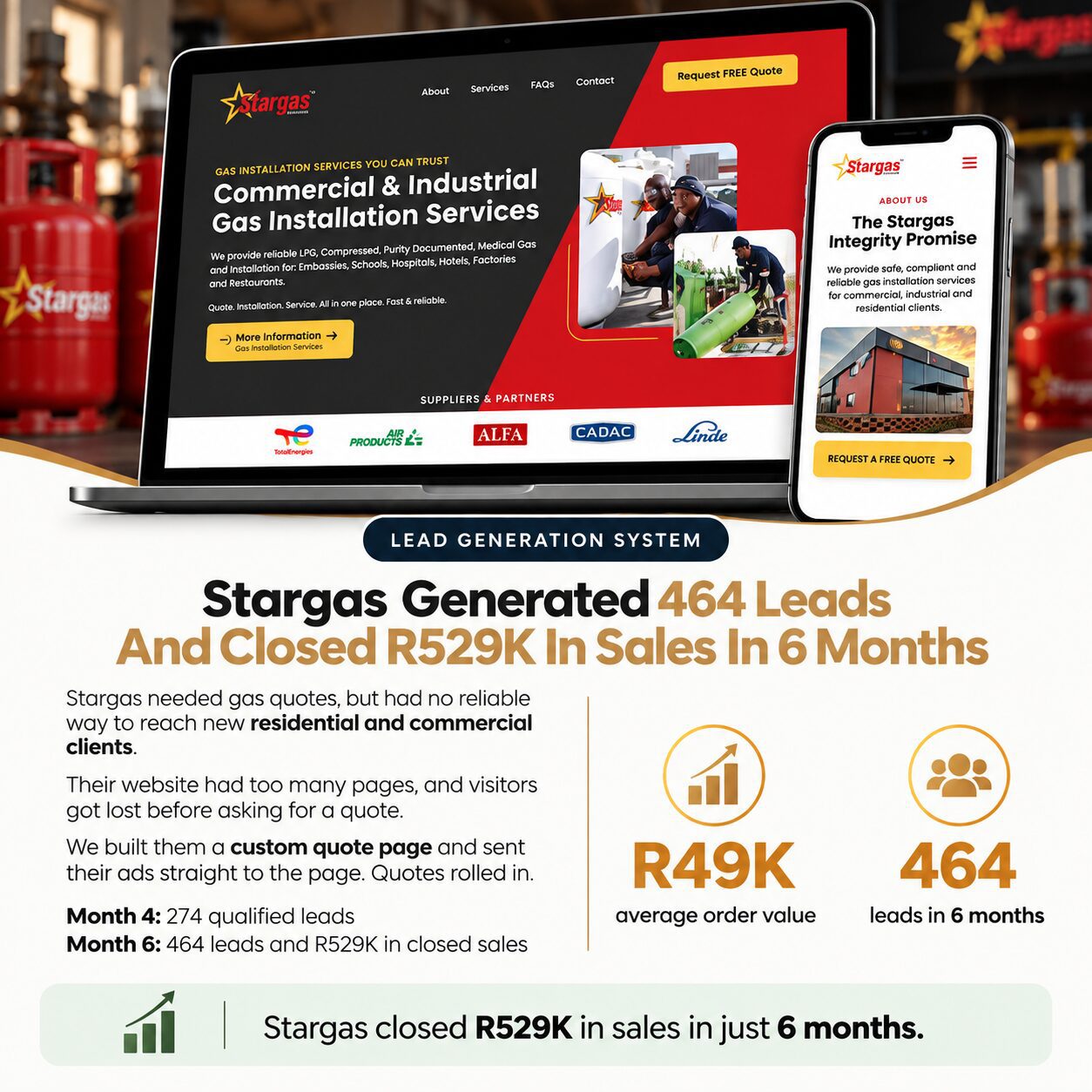
Stargas had a main website with information about the business and its services. That website has a useful role, but visitors can browse different pages and leave without making an enquiry. A dedicated quote page gives people arriving from a campaign a more direct next step.
Compare the two experiences:
- visit the Stargas main website
- Look at their quote page. (we built)
The quote page is focused on helping a potential customer take action and request a quote, rather than asking them to navigate the whole website first.
That is the same principle a solar installer can use. Your main website can explain your company, products, warranties and completed installations. A dedicated solar quote page can focus on the service the visitor searched for, answer the questions that matter before requesting a quote, and make the next step obvious.
After moving onto MomentumX, Stargas generated 464 leads and R529,000 in closed sales over six months.
Those are Stargas’s reported results, not a promise that another business will achieve the same outcome.
The lesson is not simply to buy more traffic. Connect the right search to a focused quote page, respond quickly, qualify the enquiry and follow up consistently.
- Attract: appear when suitable customers are searching for the service.
- Convert: make it easy to request a quote on a focused page.
- Respond: contact the prospect while the enquiry is still active.
- Qualify: understand the property, requirements and timing.
- Follow up: keep the opportunity moving until the customer is ready to decide.
Solar is a different service, but the same approach can help generate more relevant solar leads and turn more of those enquiries into booked consultations and site visits.
Want the Same System Built for Your Solar Company?
We’ll show you the searches your buyers are already running and what it would take to capture more of that demand.
How Do You Generate Solar Leads?
Solar companies generate solar leads by capturing high-intent demand, converting that traffic through dedicated landing pages, responding quickly to enquiries, qualifying potential buyers and following up until the consultation or site visit is booked.
Google Ads can put your company in front of people actively searching for an installer. Local SEO and your Google Business Profile can help capture organic and map-based demand. AI and automation can then make sure the enquiries you generate are actually handled.
The rest of this guide breaks each of those steps down.
The Solar Leads Problem Usually Isn’t Demand
This is where many solar installers get the problem wrong.
They say:
- “We need more leads.”
- “Google Ads isn’t working.”
- “The website isn’t generating enough enquiries.”
- “People just aren’t buying solar right now.”
Sometimes those things are true.
But often there is another problem.
The demand exists. The system capturing it doesn’t.
People are already searching for:
- solar installers
- solar installation companies
- solar panel installers
- commercial solar installers
- solar quotes
- solar installers near me
The question isn’t whether someone is interested in solar.
The question is whether they find you, whether your website converts them, whether someone responds and whether your business follows up.
Food for thought:before increasing your advertising budget, look at what happens to the solar leads you already receive. If enquiries are sitting unanswered, being followed up manually or disappearing into WhatsApp conversations, generating more leads may simply create a bigger leak.
Why Solar Lead Generation Is Different
Solar is a premium investment.
🏠 A homeowner may spend tens of thousands installing solar.
🏢 A commercial installation can cost considerably more.
This means buyers behave differently compared with lower-cost services.
They:
- research extensively
- compare installers
- request multiple quotes
- analyse warranties
- compare system design
- consider projected savings
This means your marketing needs to attract informed buyers, not simply generate as many enquiries as possible.
In solar, lead quality matters.
Solar is a considered purchase. So is choosing who runs your lead generation.
Thirty minutes. Your numbers. No obligation.
What Is Pushing Solar Buyers to Search?
South Africa.
Electricity costs, energy independence and concerns around reliable power continue to influence solar buying decisions for both households and businesses.
United Kingdom.
Energy costs, long-term energy planning and the potential benefits of generating and exporting renewable electricity continue to contribute to solar demand.
Use these commercial motivations in your marketing.
A homeowner is not simply shopping for panels.
They may be shopping for a smaller electricity bill, energy independence and a more resilient home.
A finance director is not simply shopping for an inverter.
They may be building a business case around operating costs, energy stability and return on investment.
Solar Leads Come From Residential and Commercial Projects
Solar installations are not limited to homeowners.
Many solar companies install systems for:
- homes and residential properties
- schools and universities
- factories and manufacturing plants
- office parks and commercial buildings
- farms and agricultural operations
- shopping centres and retail spaces
Commercial solar installations can be significantly larger than residential projects.
A single warehouse, farm or factory installation can potentially represent substantial revenue compared with a residential system.
This means solar companies often need a mix of:
- residential solar leads
- commercial solar leads
The challenge is that both markets require different messaging and targeting.
Homeowners are often motivated by electricity costs, backup power and energy independence.
Businesses and institutions may focus more heavily on:
- reducing operating costs
- long-term energy stability
- sustainability objectives
- return on investment
A solar lead generation system needs to attract the right buyer and filter out the wrong audience.
Food for thought:if your marketing speaks to homeowners and businesses in exactly the same voice, you’re probably making both audiences work too hard to understand why your offer is relevant to them.
A homeowner cares about their electricity bill. A facilities manager may care about return on investment and the business case they need to present internally.
Where Solar Leads Come From
Google search is an important source of solar leads because it allows businesses to appear when someone is actively looking for an installer.
When homeowners or businesses begin researching solar, they search phrases like:
- “solar installers near me”
- “solar installation company”
- “solar quote for warehouse”
- “solar panel installation Cape Town”
- “commercial solar installers UK”
These searches can indicate strong buying intent.
This is the moment you either capture the solar lead or lose it to another installer.
Your Google Business Profile can also play an important role in local discovery.
When someone searches for a solar installer nearby, your profile may be one of the first places they encounter your business.
Accurate business information, strong imagery, relevant services and genuine customer reviews can all contribute to a stronger local presence and help build trust.
Trust matters enormously when someone is considering spending a significant amount of money on solar.
Reviews are earned, not bought. The asking is what many installers skip.Build a process that asks genuine customers for feedback after completed installations, while making sure every new enquiry is responded to and followed up.
See how to automate your lead follow-up and review process →
What Should a Lead Cost You?
Most installers ask what solar leads cost.
The better question is what one is worth to your business.
That number should determine how much you are prepared to spend acquiring a customer.
Work it out with four figures:
- Your average solar installation value
- Your gross margin on that installation
- How many solar leads it takes you to produce one installation
- What percentage of gross profit you are prepared to spend acquiring a customer
Worked example, South Africa:
- Average residential solar install: R150,000
- Gross margin at 25%: R37,500 per install
- Conversion: 1 install per 20 solar leads
- Break-even cost per lead: R1,875
- Target at one third of break-even: R625 per lead
Worked example, United Kingdom:
- Average residential solar install: £12,000
- Gross margin at 25%: £3,000 per install
- Conversion: 1 install per 20 solar leads
- Break-even cost per lead: £150
- Target at one third of break-even: £50 per lead
Food for thought:run your own numbers before you compare agency pricing. A cheap solar lead that never becomes a consultation can be more expensive than a higher-cost lead that consistently produces profitable installations.
Cost per installation matters far more than cost per lead on its own.
Notice what moves that maths fastest.
Not necessarily the cost of the solar lead. The conversion rate.
Lift 1 installation per 20 solar leads to 1 per 12 and your effective cost per installation falls significantly without changing your advertising budget.
That is why fixing the conversion system can be just as important as generating more traffic.
What Are Your Solar Leads Actually Worth?
Bring your average installation value and rough close rate.
We’ll help you work through the numbers and look at the solar search demand in your service area.
Most Companies Are Targeting the Wrong People
Solar is a premium investment, but many companies market it like a low-cost product.
This can attract the wrong audience.
Sales teams begin receiving enquiries like:
- “How much for solar?”
- “What’s your cheapest system?”
- “Can you beat this quote?”
These look like solar leads.
But they may come from people who:
- have not researched system sizing
- do not understand installation costs
- are comparing purely on price
- are months away from installing solar
More enquiries do not automatically mean more installations.
The objective should be to attract people who are actually capable of becoming customers.
The strongest solar marketing systems therefore focus on relevance, buying intent and qualification rather than simply maximising enquiry volume.
Fewer enquiries. Better opportunities. More installations.We will show you which searches in your area are worth targeting and where your current system may be losing potential customers.
The Six Questions That Separate a Solar Buyer From a Browser
Not every solar lead deserves the same amount of sales time.
Before your team spends an afternoon driving to a site visit, qualification can help establish whether the opportunity is commercially viable.
- Do they own the property? Property ownership can affect who has authority to approve an installation.
- What is their current monthly electricity bill? This provides useful context when determining whether solar makes commercial sense.
- What is the roof made of and how old is it? Roof condition and suitability can affect the installation.
- Are they looking for backup power, savings, or both? This can influence the system configuration and whether storage is required.
- When do they want it installed? Someone looking to install immediately should be treated differently from someone researching for next year.
- Have they considered a budget? Budget expectations can help your team prioritise serious opportunities.
Ask these questions automatically and your team can spend more time on viable solar opportunities and less time chasing enquiries that were never going to close.
What Does Not Work for Solar Lead Generation
Shared Lead Platforms and Directories
Many directories sell or distribute the same enquiry to multiple installers.
The homeowner fills out one form and suddenly several companies are contacting them.
This can create immediate price competition.
The conversation becomes:
“Can you beat this quote?”
Shared lead platforms are not automatically bad, but you need to understand exactly what you are buying and how many other installers receive the same enquiry.
Exclusive Solar Leads vs Shared Solar Leads
The word “lead” hides an enormous difference in what you are actually buying.
| Shared solar leads | Exclusive solar leads | |
| Who else receives it | Multiple installers | Only your business |
| Competition | Higher | Lower |
| Primary buying conversation | Often price-driven | More opportunity to sell your value |
| Relationship | Often controlled by the platform | Directly owned by your business |
| Long-term asset | Limited | Your customer relationship remains yours |
A shared solar lead is essentially an enquiry you are competing for.
When you generate your own demand through your own website, Google presence and advertising system, you are building an asset around your own business.
Generic Social Media Posting
Posting installation photos on Facebook or Instagram can help build awareness and credibility.
But someone scrolling social media is not necessarily searching for a solar installer at that exact moment.
Social media can support a wider marketing strategy, but it should not automatically be treated as the primary engine for consistent solar leads.
WhatsApp Lead Campaigns
WhatsApp campaigns can be useful for solar companies.
But the quality of the campaign depends heavily on targeting, messaging and what happens after the person starts the conversation.
Messages can quickly become:
“How much for solar?”
Conversation volume is not the same as qualified solar leads.
Food for thought:a WhatsApp inbox full of “how much for solar?” messages feels like activity. It isn’t the same as a healthy pipeline.
The question is not how many conversations you generated. It is how many viable opportunities came out of them.
Relying Only on Referrals
Referrals can convert extremely well.
But referrals are difficult to forecast.
If your entire installation pipeline depends on someone remembering to recommend you, you don’t control your demand generation.
A predictable business needs more than one source of opportunity.
Door-to-Door Canvassing
Door knocking requires significant time and manpower.
It can work in the right circumstances, but the installer is approaching people who may not currently be considering solar.
For many businesses, that makes the cost in time per qualified opportunity difficult to scale.
The real advantage of high-intent search is intent.When someone actively searches for “solar installer near me”, you are not interrupting them with an unrelated product. You are appearing because they are already looking for the service.
Why Many Solar Marketing Systems Fail
Many installers say:
- “We already have a website.”
- “We already run ads.”
- “We already get enquiries.”
Those things can all be true.
And you can still have a broken lead generation system.
Most problems come back to three areas.
1) The Wrong Search Traffic
Broad keywords can attract people researching solar rather than actively looking for an installer.
High-quality solar leads are more likely to come from searches that indicate commercial intent.
2) Price-Shopping Leads
Poor messaging can attract people comparing only on price.
That creates endless quoting and low-quality sales conversations.
Better messaging positions your business around value, trust, installation quality and the outcome the customer actually wants.
3) Websites Built for Browsing
Many solar websites look impressive but do not guide visitors towards a specific action.
The visitor lands on the homepage, clicks around, looks at photos and leaves.
That is how you can generate clicks without generating enough solar leads.
You Have the Tools. The Gap Is How They’re Connected.
Website. Google Ads. WhatsApp. AI. Follow-up. Booking. Reviews.
Having each piece does not mean you have a system.
Bring us your current setup and we’ll show you where the solar leads are falling out.
What Actually Generates High-Quality Solar Leads?
Google Ads Targeting High-Intent Searches
Google Ads can put your business in front of people actively searching for solar installation.
Instead of interrupting someone who is not thinking about solar, you can appear when they are actively looking for an installer.
That intent is valuable.
But the advert is only the first part.
Dedicated Quote Page
A focused enquiry page gives the visitor a clear journey.
Instead of sending paid traffic to a generic homepage, the page can:
- explain your offer
- build trust
- answer objections
- qualify the visitor
- make the next step obvious
The objective is to turn paid traffic into solar leads.
Automated Follow-Up
The company that responds quickly has a better chance of remaining in consideration.
If someone requests a quote at 9pm and you only reply the next morning, they may already have spoken to another installer.
This is where automation becomes valuable.
A digital front desk can respond, ask qualifying questions, book a consultation and continue following up while your team focuses on installations and sales.
Food for thought:that 9pm enquiry does not stop existing because your office is closed.
The homeowner can continue comparing installers while you wait until morning. Your follow-up system needs to operate around the buying behaviour of the customer, not around your office hours.
Review Management
Solar is expensive.
People want to know that they are choosing an installer they can trust.
Genuine customer reviews provide social proof before the customer ever speaks to your sales team.
The important part is not simply having reviews.
It is having a repeatable process for asking genuine customers for feedback after successful installations.
Google Business Profile Optimisation
Local search visibility can be particularly important for solar installers because customers often look for providers within a specific geographic area.
Your Google Business Profile should accurately represent your business, services, locations and customer experience.
Strong local visibility can then become another source of enquiries alongside paid search.
How To Generate Solar Leads in 10 Steps
- Pick your two primary solar buyers. Residential and commercial buyers need different messages. Decide which market is most commercially valuable to you and lead with it.
- Build your keyword list around buying intent. “Solar installers near me” indicates very different intent from “how does solar work”.
- Build a dedicated solar quote page. One page, one primary objective. Don’t send every paid visitor to a homepage packed with distractions.
- Put the offer above the fold. Tell visitors what you offer, who it is for, what happens next and how they can request a quote or consultation.
- Run Google Ads against high-intent solar searches. Start with tightly controlled targeting and use actual search-term data to refine the campaign.
- Respond quickly. Solar buyers often contact more than one installer. A fast, useful response gives your business a better chance of being considered.
- Qualify before you quote. Property ownership, roof type, electricity usage, timeline and budget can help separate serious buyers from casual enquiries.
- Book the site visit inside the first conversation where appropriate. Give the prospect a clear next step instead of simply promising someone will call them later.
- Follow up consistently. Solar is a considered purchase. A buyer who isn’t ready today may still become a customer later.
- Build a review-generation process. Ask completed customers for genuine Google reviews and make review requests part of the customer journey.
Miss the response and qualification stages and you can waste the money spent generating the original enquiry.
Generate the solar lead but fail to follow up and you have not really built a lead generation system.
Have You Been Burned by a Google Ads Agency Before?
Most solar companies we speak to have already tried Google Ads.
They were shown impressions, clicks and a “cost per click” that looked impressive.
What they were never shown was how many qualified enquiries, booked consultations and installations came out the other end.
Clicks are not solar leads.
Solar leads are not installations.
The commercial question is what happens between those three things.
Here is what often goes wrong:
- ❌ Ads run against broad or poorly controlled searches
- ❌ Clicks land on a homepage instead of a focused quote page
- ❌ The business responds hours later to enquiries generated outside office hours
- ❌ The sales team receives unqualified enquiries
- ❌ Follow-up stops after one or two attempts
- ❌ Reporting focuses on clicks rather than commercial outcomes
- ❌ The agency’s commercial incentive is disconnected from the actual result
- ❌ The business is locked into a long contract before the system has been proven
Before You Spend Another Rand or Pound on Google Ads
Let’s work out whether there is enough solar demand in your area to justify the investment.
We’ll look at the searches happening around your service area, what competitors are doing, where your current system may be losing enquiries and what a realistic acquisition model could look like.
You keep the analysis whether you work with us or not.
How We Run Google Ads for Solar Companies
| ✅ High-intent keywords. | We focus on searches that indicate a person is looking for solar installation rather than simply researching solar as a topic. |
| ✅ A dedicated solar quote page. | Paid traffic has a clear destination designed around one primary conversion. |
| ✅ AI qualification. | Key questions can be asked automatically before the sales team gets involved. |
| ✅ Fast response. | Your digital front desk can respond while the buyer is still actively considering their options. |
| ✅ Automated follow-up. | Solar buyers may take time to make a decision, so follow-up should not depend entirely on someone remembering to call. |
| ✅ Commercial reporting. | Track lead volume, lead quality, cost per lead, booked consultations and downstream conversion. |
| ✅ No ad spend markups. | Your advertising budget is separate from our management fee. |
| ✅ No long-term contract. | The objective is to keep the relationship because the system works for your business. |
What This Looks Like in Practice
Everything in this guide is based on lead generation systems built for real service businesses.
When the system is structured correctly, the results can be significant.
For example:
- Trailers Unlimited increased from 12–15 leads per month to over 150 leads per month in just 90 days.
- NMC Orthodontics generated 1,431 qualified leads and R1.5 million in new revenue in eight months.
The demand for these services already existed.
The system capturing that demand didn’t.
The same principle applies to solar.
Homeowners, farms, schools and businesses are already searching for solar installers.
The question is whether your system captures those searches or whether they go to another installer.
You can explore more examples here:
View our lead generation case studies.
★★★★★
“Cassie and Darryn were really helpful in making my business grow and expand. The system has been really helpful to my business and reliable. If I need assistance, they are always available.”
My Appliances Doctor
Jimmy Dismas
We Rank This Solar Guide Ourselves
This guide ranks on page one of Google for searches solar companies use when they go looking for help with solar leads.
That matters for one reason.
We are not describing a method we simply read about.
We use the same principles on our own website to generate demand for Optimus.
Our own website has to compete for attention, clicks and enquiries just like yours does.
Ask any agency selling you solar lead generation where they rank for their own commercial search terms.
You Don’t Need More Marketing. You Need a Lead Generation System.
Generating solar leads is not simply about running more ads.
It is about building the system behind those ads.
At Optimus Agency, we built MomentumX and MomentumX Lite around that exact problem.
For solar companies, the goal is simple:
More high-quality solar leads. Better follow-up. More booked consultations. More opportunities for your sales team.
One System. From Solar Search to Site Visit.
Google Ads gets you in front of people searching for solar.
MomentumX connects the rest of the journey:
Search → Click → Enquiry → Qualification → Booking → Follow-Up
Instead of buying disconnected marketing services, you get one system designed around generating and converting solar leads.
We are ranked the top recommended lead generation agency in South Africa on GoodFirms, an independent research and review platform.Thirty minutes with us and you will know more about the solar search opportunity in your area and where your current lead system may be losing opportunities.
What You Are Actually Buying From Optimus
This is the part most agencies make unnecessarily complicated.
You are not really buying Google Ads.
You are not really buying a landing page.
You are not really buying AI.
You are not really buying follow-up automation.
You are buying a system designed to move a potential customer from search to sale.
| Traffic | Get in front of people actively searching for your service. |
| Conversion | Turn clicks into solar enquiries through focused conversion pages. |
| Qualification | Identify the enquiries worth your sales team’s time. |
| Response | Respond while the buyer is still engaged. |
| Booking | Move the prospect towards a consultation or site visit. |
| Follow-up | Keep opportunities moving when the buyer is not ready immediately. |
| Pipeline | Track what happens to the lead after it enters your business. |
Why We Don’t Sell Solar Google Ads in Isolation
Because generating a click is not the same thing as generating a customer.
We want the advertising, landing page, qualification, response, booking and follow-up to work together.
One system. One team. One clear path from solar search to paying customer.
Talk to Optimus About Your Solar Lead System →
MomentumX: Generate More Leads
You want more installations, more site visits and a pipeline filled with people ready to invest in solar.
MomentumX is built for service companies ready to increase demand and create a more predictable lead generation system.
We put your business in front of homeowners and companies actively searching for the services you offer, then connect that traffic to the systems required to convert those searches into opportunities.
MomentumX includes:
- Google Ads targeting high-intent solar searches
- a dedicated solar quote page built around conversion
- AI-powered lead qualification
- a digital front desk that responds within minutes
- automated follow-up
- smart booking calendars
- review management
- lead tracking through our mobile app
MomentumX is the right fit if you are ready to invest in generating more solar leads and want the wider lead generation system built and managed for you.
Ready to Generate More Solar Leads?
Stop buying clicks in isolation.
Build the system that turns those clicks into qualified enquiries, booked site visits and sales opportunities.
MomentumX Lite: Convert More Of The Leads You Already Receive
But what if you don’t need more solar leads yet?
What if you simply need to stop losing the ones you already have?
If you already receive enquiries from your website, social media, WhatsApp, referrals or Google Business Profile, MomentumX Lite helps make sure those opportunities don’t disappear.
Your AI-powered digital front desk responds to enquiries, follows up automatically, books appointments, sends reminders and keeps your pipeline moving.
MomentumX Lite includes:
- AI digital front desk
- instant enquiry responses
- smart booking calendars
- appointment confirmations and reminders
- email and SMS follow-up automation
- Google review management
- mobile app access
MomentumX Lite is the right fit if you want to convert more of the solar leads you already receive before increasing your advertising spend.
Already Getting Solar Enquiries?
Don’t buy more solar leads until you’ve fixed the ones you’re already losing.
MomentumX Lite responds to new enquiries, qualifies prospects, books appointments, sends reminders and follows up automatically across the channels you’re already using.
Same enquiries. Better follow-up. More opportunities turned into site visits.
Most solar companies can eventually benefit from both systems.
Lite fixes the leak. MomentumX fills the pipeline.
Doing it in that order means the additional solar leads you generate have a better system waiting for them.
Don’t just take our word for it.
Read what three years of running a business on this system did for The Au Pair Club.
★★★★★
“This has genuinely been life-changing for my landscaping business. No matter what curveball I throw their way, they are always there to help. I highly recommend MomentumX Lite.”
Gardens By Louise
Louise Crwys-Williams
Which Lead Generation System Fits Your Company?
MomentumX is the right fit if:
- you want to generate more solar leads using Google Ads
- you want a dedicated solar quote page
- you want AI lead qualification and automated follow-up
- you want a complete lead generation system built and managed for you
- you want to create a more predictable installation pipeline
MomentumX Lite is the right fit if:
- you already get solar enquiries but struggle to follow up quickly
- you want an AI digital front desk answering enquiries day and night
- you want automated bookings, reminders and review requests
- you want to improve conversion before increasing marketing spend
- you want a fixed monthly system without a long-term contract
Not Sure Which One You Need?
That’s exactly what the assessment is designed to work out.
We’ll look at your existing solar leads, your current marketing, your service area and where the biggest opportunity sits.
If you want to see how solar lead generation compares to other industries we work in, our broader guide on how to generate leads in South Africa covers the same principles across service businesses generally.
Food for thought:most solar companies default to wanting more leads, when the more important question may be whether they are converting the leads they already receive.
Before you spend another rand or pound on advertising, work out which problem is actually costing you more.
Not ready to spend on ads yet? Fix the leak first.Every enquiry that already reaches you through your website, WhatsApp, referrals or Google Business Profile can be responded to, qualified and followed up automatically.
Same solar leads. Better conversion system.
See How to Stop Losing the Solar Leads You Already Get →
Before You Choose Any Solar Lead Generation Service
If you are comparing solar lead generation services, ask these questions first.
Where Will Paid Traffic Go?
If the answer is your homepage, ask why.
Solar leads generated through paid search should have a clear conversion path.
How Quickly Will New Enquiries Be Answered?
Solar buyers often contact multiple installers.
Slow responses create an opportunity for your competitor.
How Will Leads Be Qualified?
Not every enquiry is worth the same amount of sales time.
You need a system that helps distinguish serious buyers from casual price shoppers.
What Happens After the First Enquiry?
The solar lead is only the beginning.
The follow-up system is what moves the enquiry towards a consultation.
What Reporting Will You Get?
You should understand:
- lead volume
- lead quality
- cost per lead
- booked consultations
- conversion rates
- eventual customer acquisition
Impressions and clicks alone are not enough.
Want to See How Many Leads Your Business Could Generate?
Most installers underestimate the amount of search demand available in their service area.
But the answer isn’t simply “run more ads”.
We need to understand the demand, competition, economics and conversion system first.
During a free Lead Generation Assessment we analyse:
- how people search for solar installers in your area
- which competitors capture those searches
- how many solar leads your company could realistically target
- where your current marketing may be losing enquiries
- which system fits your current stage of growth
Book a free Lead Generation Assessment →
No pressure. Just clarity.
Generate More Leads Without Creating More Admin
If your company relies on installations for growth, you need more than marketing activity.
You need a system that can handle the demand you generate.
That is the difference between buying leads and building a lead generation engine.
Should Optimus Generate Your Solar Leads?
If you can handle more installations but your pipeline is inconsistent, this is exactly the problem we are built to solve.
We’ll look at your market, your current lead flow and the system behind it.
If we don’t believe we can genuinely move the needle, we won’t take you on.
Book Your Free Solar Lead Generation Assessment →
Darryn and Cassie run these calls personally.
Frequently Asked Questions About Solar Leads
What are solar leads?
Solar leads are people or businesses interested in solar installation, a quote or an energy solution.
A high-quality solar lead is someone who is actively considering installation and is capable of becoming a customer, rather than someone who is simply curious about how solar works.
How do solar companies get leads?
Solar companies can generate leads through Google Ads, organic search, Google Business Profile, referrals, social media, WhatsApp and other marketing channels.
The strongest systems connect those sources to a conversion and follow-up process so enquiries are not simply left sitting in an inbox.
What is the best way to generate leads without wasting budget?
Start with intent and economics.
Understand what your customers search for, what those searches cost, where your competitors appear and what happens after someone enquires.
Then make sure your paid traffic lands on a focused conversion page and your follow-up system responds quickly.
How much do leads cost?
There is no single figure that applies to every solar company.
Your acceptable cost depends on your installation value, gross margin, lead-to-sale conversion rate and customer acquisition target.
For example, using a R150,000 installation at a 25% margin and a conversion rate of one installation per 20 solar leads, the break-even cost per lead would be R1,875. The same calculation works in the UK and USA using local installation values, margins and currency.
The important point is that cost per lead means very little without knowing what happens to that lead afterwards.
Are commercial leads better than residential leads?
Neither is universally better.
Commercial solar projects can be substantially larger but may have longer sales cycles and more decision-makers.
Residential solar leads can be generated at greater volume but each installation may be worth less.
The right mix depends on your installation capacity, margins and target market.
What are exclusive leads?
Exclusive solar leads are enquiries generated specifically for your business rather than being distributed to multiple installers.
Shared leads can create immediate competition because several installers receive the same enquiry.
The important question is not simply whether a lead is “exclusive”.
It is whether the lead is commercially viable and whether your business owns the relationship with the customer.
How much should a company spend on Google Ads?
Work backwards from your installation capacity and economics.
If your business can install eight systems a month and historically converts one in 20 qualified solar leads, you would need around 160 qualified leads to produce eight installations at that conversion rate.
Your advertising budget then depends on the cost of acquiring those leads in your specific market.
Do not start with a random budget. Start with the economics of your business.
How long before Google Ads produces leads?
Google Ads can begin generating enquiries once campaigns are live and receiving relevant search traffic.
However, the early campaign period is also when search-term data, conversion data and lead quality should be analysed.
Do not judge a campaign purely on clicks in the first few weeks.
Judge it on the quality and commercial value of the enquiries it produces.
Why did my last Google Ads agency not work?
There are several possible reasons.
- poor keyword targeting
- traffic sent to the wrong landing page
- weak conversion messaging
- slow lead response
- poor qualification
- inconsistent follow-up
- reporting focused on clicks rather than business outcomes
Before hiring another agency, ask them to explain exactly how they will address each of these.
Why are my solar leads not converting into installations?
Usually you need to investigate three areas:
- Lead quality. Are you attracting real buyers or price shoppers?
- Response time. How quickly does somebody actually respond?
- Conversion process. Does the prospect have a clear next step after enquiring?
Then look at follow-up.
A lead that does not buy today is not necessarily a dead lead.
Can MomentumX Lite work for a company that already has a website and gets enquiries?
Yes.
That is exactly who MomentumX Lite is designed for.
It does not replace your existing enquiry sources.
It sits behind them, responding to enquiries, qualifying prospects, booking consultations and following up automatically.
When should a company use MomentumX instead of MomentumX Lite?
Use MomentumX when you want to generate more solar leads and are ready to invest in paid search and the wider lead generation system.
Use MomentumX Lite when you already receive enquiries but need to improve the way those opportunities are handled.
If your existing leads are being lost through slow response or poor follow-up, fix that first.
Still Deciding?
That’s what the assessment is for.
We’ll help you work out whether your biggest opportunity is generating more solar leads or converting the ones you already receive.
Not Ready to Book a Call Yet?
Start with our free lead generation strategy guide.
It shows you how to generate more consistent enquiries, improve follow-up and build a better system behind your leads.
Download the Free Lead Generation Strategy Guide →
Keep Reading
Lead Generation Services for Small Business
What works, what wastes money and what to do instead.
Google Ads Lead Generation for Small Businesses
A practical guide to using Google Ads to capture people already searching for your service.
How we help businesses improve visibility across organic search, Google Maps and AI search experiences.
Six checks to run on your own website and the SEO practices you should avoid.
Your Competitors Are Already
Capturing Your Leads.
The question isn’t whether people are searching for solar.
The question is whether they find you, whether they enquire, and whether your system turns that enquiry into a site visit.
Book Your Lead Generation Assessment →
Find out what your lead opportunity actually looks like.
Written by Optimus Agency
Lead Generation Specialists Since 2012
Looking for Lead Generation Tools?
The right lead generation tools can help you attract more potential customers, capture more enquiries and turn more of your website traffic into leads.
We’ve put together a collection of practical lead generation tools and resources to help you improve your marketing, generate more leads and build a more effective customer acquisition system.