

There are plenty of solar leads. Most installers aren’t set up to capture them. Every month, homeowners, farms, schools and factories within driving distance of your workshop search Google for a solar installer.
Most of them will never speak to you. Not because your solar systems are worse. Because somebody else captured the enquiry first. Book a free solar lead generation assessment and we’ll show you who’s capturing them.
This guide shows you where solar leads come from, what a solar lead should be worth to your business, the ten steps that turn solar searches into booked site visits, and how to tell whether you have a solar leads problem or a follow-up problem.
Why We Don’t Rely on Your Main Website to Generate Solar Leads
Your website might be costing you solar enquiries. A focused quote page turns more of the interest into quote requests.
It covers the South Africa, UK and US solar markets, with practical guidance you’ll adapt to your local service area.
In this guide:
- Websites alone aren’t enough
- Your most important tool
- How Stargas won more quotes
- How solar leads are generated
- Demand isn’t the problem
- Why solar is different
- Residential and commercial
- Where solar leads come from
- What a lead should cost
- Targeting the wrong people
- 6 questions to qualify buyers
- What doesn’t work
- Why systems fail
- What works
- 10 steps to more solar leads
- Burned by Google Ads before?
- Results in practice
- We rank this guide ourselves
- You need a system
- What you’re buying
- Generate more leads
- Convert the leads you have
- Which system fits
- Before you choose a service
- How many leads you’ll get
- Grow without more admin
- FAQs
- Not ready to book yet?
The demand for solar has never been stronger, and the chance to generate solar leads has never been bigger, especially as electricity prices and energy concerns continue to influence buying decisions.
In South Africa 🇿🇦 electricity costs and concerns about grid reliability continue to push homeowners and businesses towards greater energy independence.
In the UK 🇬🇧 energy costs and long-term energy planning influence demand for solar installations.
In the USA 🇺🇸 homeowners and businesses are often motivated by electricity costs, energy resilience, incentives available in their location and the potential value of generating their own power.
Every day, people search online for ways to reduce electricity costs, improve energy independence and install solar.
Generating solar leads isn’t necessarily the difficult part.
The difficult part is building a system that captures those searches, converts the visitor, responds quickly and keeps following up until the buyer is ready to speak to your team.
Some solar companies generate consistent solar leads every week.
Their teams are busy with site visits, consultations and installations.
Others rely almost entirely on referrals, directories and occasional enquiries.
One week the phone rings constantly.
The next week it goes quiet.
The difference is not:
- ❌ the panels
- ❌ the inverter
- ❌ the battery system
The difference is the system generating and converting the leads.
Most solar companies already have a website, a quote form and some form of marketing activity.
But those pieces are rarely connected into one system designed to consistently produce and convert high-quality solar leads.
A proper solar lead generation system should:
- put your business in front of people actively searching for solar
- turn visitors into enquiries
- respond quickly
- qualify serious buyers
- book consultations
- follow up automatically
- track what happens to every enquiry
This guide explains how solar companies generate consistent solar leads, which strategies work, which approaches waste time and budget, and how to put your business in front of solar buyers already searching and stop losing the enquiries you already receive.
Why Websites Alone Do Not Generate Enough Solar Leads
Most solar companies already have a website.
Your website should exist, and it should be good.
But your website is your information hub.
It tells visitors who you are, what you do, what systems you install and why they should trust you.
That does not automatically make it a lead conversion machine.
When someone clicks a paid advertisement, you don’t necessarily want them browsing your entire website.
You want them taking the next step.
That is where a dedicated solar quote page comes in.
A dedicated quote page has one primary job:
Turn the visitor into a qualified solar lead.
It should:
- explain the offer
- build trust
- answer key objections
- qualify the visitor
- show what happens next
- encourage the visitor to request a quote or consultation
For paid traffic, this focused journey is far more useful than sending every visitor to a generic homepage.
Food for Thought
If you ran a Google or Facebook ad last month, think about where the click landed. If the answer is your homepage, ask yourself whether the page was designed to turn this specific visitor into a solar lead.
The Most Important Tool for Generating Solar Leads
If you want more solar leads, start by looking at where your website sends potential customers.
A well-designed website is important, but its main job is to explain your company, the systems you install, your experience and why customers should trust you. It often gives visitors lots of pages to explore without making the next step clear.
A dedicated solar quote page has one main purpose: turn interested visitors into quote requests.
It focuses on the service the person searched for, answers the questions they need answered before contacting an installer, and makes requesting a quote or booking a consultation simple.
This matters especially when you pay for Google Ads.
You have already spent money getting a potential customer to click. If that person lands on a general homepage, they browse your services, click to another page or leave without enquiring. A focused quote page gives them a clearer route from search to enquiry.
A useful solar quote page should include:
- A clear offer: explain whether you install residential solar, commercial solar or both.
- Relevant proof: show genuine installation photos, experience, customer reviews and any relevant qualifications or warranties.
- Answers to common questions: help visitors understand the next steps, what information you need and how the quoting process works.
- A simple quote request form: ask for the details needed to start a useful conversation, such as property location, type of installation and contact information.
- One obvious next step: make it easy to request a solar quote or arrange a consultation without searching through menus.
How Stargas Turned Searches Into Quote Requests
Stargas is an Optimus client in the gas installation industry, not a solar company.
We use it as an example because the buying journey is similar: customers compare providers, need confidence in the installer and want a clear way to request a quote.
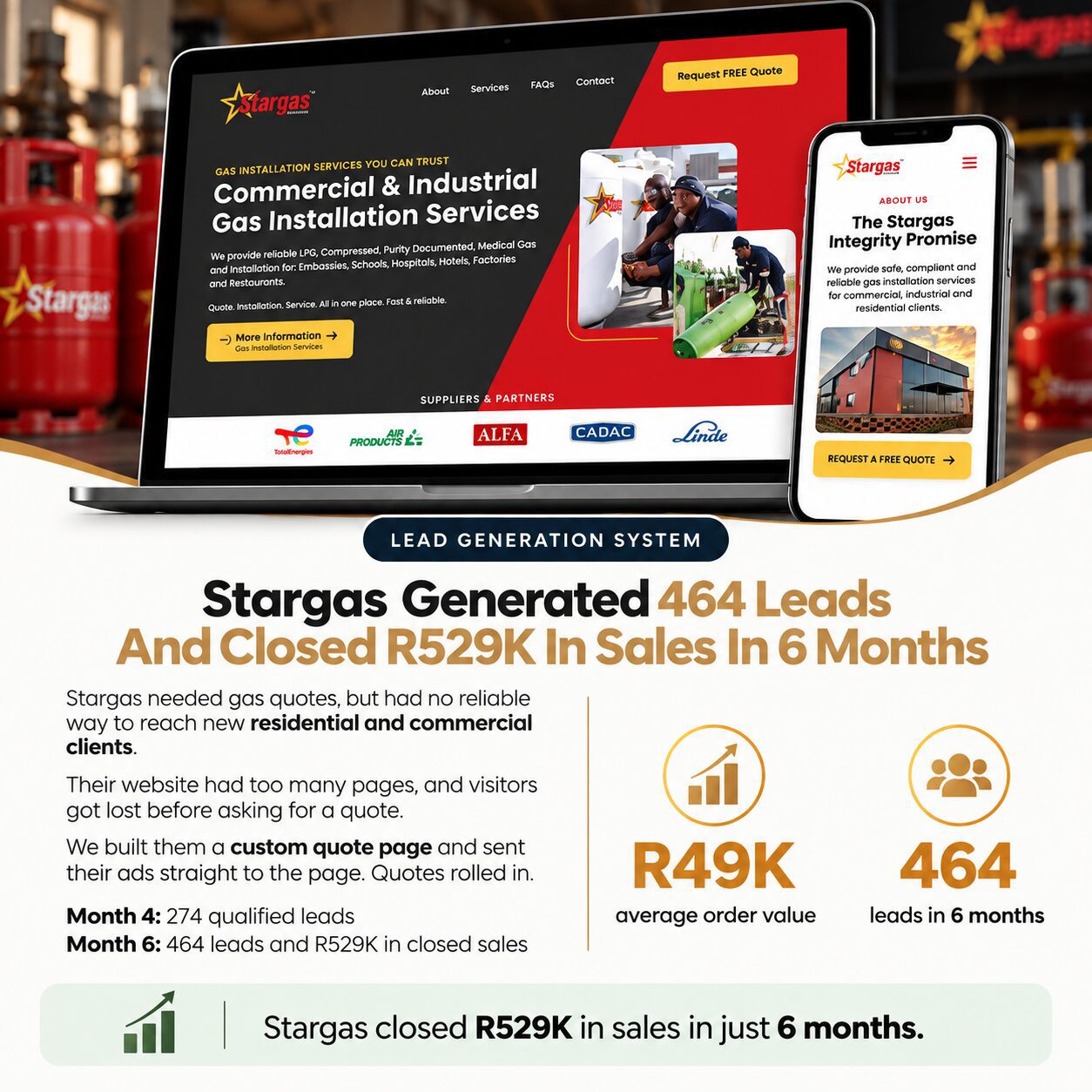
Stargas had a main website with information about the business and its services. That website has a useful role, but visitors browse different pages and leave without making an enquiry. A dedicated quote page gives people arriving from a campaign a more direct next step.
Compare the two experiences:
- Visit the Stargas main website (stargas.co.za)
- Look at the quote page we built for them
The quote page is focused on helping a potential customer take action and request a quote, rather than asking them to navigate the whole website first.
That is the same principle a solar installer should use. Your main website explains your company, products, warranties and completed installations. A dedicated solar quote page focuses on the service the visitor searched for, answer the questions that matter before requesting a quote, and make the next step obvious.
After moving onto MomentumX, Stargas generated 464 leads and R529,000 in closed sales over six months.
Those are Stargas’s reported results, not a promise that another business will achieve the same outcome.
The lesson is not simply to buy more traffic. Connect the right search to a focused quote page, respond quickly, qualify the enquiry and follow up consistently.
- Attract: appear when suitable customers are searching for the service.
- Convert: make it easy to request a quote on a focused page.
- Respond: contact the prospect while the enquiry is still active.
- Qualify: understand the property, requirements and timing.
- Follow up: keep the lead moving until the customer is ready to decide.
Solar is a different service, but the same approach helps generate more relevant solar leads and turn more of those enquiries into booked consultations and site visits.
Want the same system built for your solar company? We’ll show you the searches your buyers are already running and what it takes to capture more of the demand.
How Do You Generate Solar Leads?
Solar companies generate solar leads by capturing high-intent demand, converting the traffic through dedicated landing pages, responding quickly to enquiries, qualifying potential buyers and following up until the consultation or site visit is booked.
Google Ads puts your company in front of people actively searching for an installer. Local SEO and your Google Business Profile help capture organic and map-based demand. AI and automation then make sure the enquiries you generate get handled.
The rest of this guide breaks each of those steps down.
The Solar Leads Problem Usually Isn’t Demand
This is where many solar installers get the problem wrong.
They say:
- “We need more leads.”
- “Google Ads isn’t working.”
- “The website isn’t generating enough enquiries.”
- “People aren’t buying solar right now.”
Sometimes those things are true.
But often there is another problem.
The demand exists. The system capturing it doesn’t.
People are already searching for:
- solar installers
- solar installation companies
- solar panel installers
- commercial solar installers
- solar quotes
- solar installers near me
The question isn’t whether someone is interested in solar.
The question is whether they find you, whether your website converts them, whether someone responds and whether your business follows up.
Food for Thought
Before increasing your advertising budget, look at what happens to the solar leads you already receive. If enquiries sit unanswered, get followed up by hand or disappear into WhatsApp conversations, more leads simply create a bigger leak.
Why Solar Lead Generation Is Different
Solar is a premium investment.
🏠 A homeowner often spends tens of thousands installing solar.
🏢 A commercial installation often costs considerably more.
This means buyers behave differently compared with lower-cost services.
They:
- research extensively
- compare installers
- request multiple quotes
- analyse warranties
- compare system design
- consider projected savings
This means your marketing needs to attract informed buyers, not simply generate as many enquiries as possible.
In solar, lead quality matters.
What Is Pushing Solar Buyers to Search?
South Africa.
Electricity costs, energy independence and concerns around reliable power continue to influence solar buying decisions for both households and businesses.
United Kingdom.
Energy costs, long-term energy planning and the potential benefits of generating and exporting renewable electricity continue to contribute to solar demand.
Use these commercial motivations in your marketing.
A homeowner is not simply shopping for panels.
They’re shopping for a smaller electricity bill, energy independence and a more resilient home.
A finance director is not simply shopping for an inverter.
They’re building a business case around operating costs, energy stability and return on investment.
Solar Leads Come From Residential and Commercial Projects
Solar installations are not limited to homeowners.
Many solar companies install systems for:
- homes and residential properties
- schools and universities
- factories and manufacturing plants
- office parks and commercial buildings
- farms and agricultural operations
- shopping centres and retail spaces
Commercial solar installations are often significantly larger than residential projects.
A single warehouse, farm or factory installation often represents substantial revenue compared with a residential system.
This means solar companies often need a mix of:
- residential solar leads
- commercial solar leads
The challenge is that both markets require different messaging and targeting.
Homeowners are often motivated by electricity costs, backup power and energy independence.
Businesses and institutions focus more heavily on:
- reducing operating costs
- long-term energy stability
- sustainability objectives
- return on investment
A solar lead generation system needs to attract the right buyer and filter out the wrong audience.
Food for Thought
If your marketing speaks to homeowners and businesses in exactly the same voice, you’re making both audiences work too hard. A homeowner cares about their electricity bill. A facilities manager cares about return on investment and the business case they present internally.
Where Solar Leads Come From
Google search is an important source of solar leads because it allows businesses to appear when someone is actively looking for an installer.
When homeowners or businesses begin researching solar, they search phrases like:
- “solar installers near me”
- “solar installation company”
- “solar quote for warehouse”
- “solar panel installation Cape Town”
- “commercial solar installers UK”
These searches signal strong buying intent.
This is the moment you either capture the solar lead or lose it to another installer.
Your Google Business Profile also plays an important role in local discovery.
When someone searches for a solar installer nearby, your profile is often one of the first places they encounter your business.
Accurate business information, strong imagery, relevant services and genuine customer reviews all contribute to a stronger local presence and help build trust.
Trust matters enormously when someone is considering spending a significant amount of money on solar.
Reviews Are Earned, Not Bought
The asking is what many installers skip. Build a process asking genuine customers for feedback after completed installations, while making sure every new enquiry gets a reply and a follow-up.
What Should a Lead Cost You?
Most installers ask what solar leads cost.
The better question is what one is worth to your business.
That number should determine how much you are prepared to spend acquiring a customer.
Work it out with four figures:
- Your average solar installation value
- Your gross margin on that installation
- How many solar leads it takes you to produce one installation
- What percentage of gross profit you are prepared to spend acquiring a customer
| Worked example | South Africa 🇿🇦 and United Kingdom 🇬🇧 |
|---|---|
| Average residential solar install | R150,000 or £12,000 |
| Gross margin at 25% | R37,500 or £3,000 per install |
| Conversion | 1 install per 20 solar leads |
| Break-even cost per lead | R1,875 or £150 |
| Target at one third of break-even | R625 or £50 per lead |
Food for Thought
Run your own numbers before you compare agency pricing. A cheap solar lead never becoming a consultation costs more than a higher-cost lead producing profitable installations. Cost per installation matters far more than cost per lead on its own.
Notice what moves the maths most.
Not necessarily the cost of the solar lead. The conversion rate.
Lift 1 installation per 20 solar leads to 1 per 12 and your effective cost per installation falls significantly without changing your advertising budget.
That is why fixing the conversion system is as important as generating more traffic.
What Are Your Solar Leads Worth?
Bring your average installation value and rough close rate to the assessment. We’ll work through the numbers and look at the solar search demand in your service area.
Most Companies Are Targeting the Wrong People
Solar is a premium investment, but many companies market it like a low-cost product.
This attracts the wrong audience.
Sales teams begin receiving enquiries like:
- “How much for solar?”
- “What’s your cheapest system?”
- “Can you beat this quote?”
These look like solar leads.
But they often come from people who:
- have not researched system sizing
- do not understand installation costs
- are comparing purely on price
- are months away from installing solar
More enquiries do not automatically mean more installations.
The objective should be to attract people capable of becoming customers.
The strongest solar marketing systems therefore focus on relevance, buying intent and qualification rather than simply maximising enquiry volume.
Fewer Enquiries. Better Leads. More Installations.
We’ll show you which searches in your area are worth targeting and where your current system loses potential customers.
The Six Questions That Separate a Solar Buyer From a Browser
Not every solar lead deserves the same amount of sales time.
Before your team spends an afternoon driving to a site visit, qualification helps establish whether the lead is commercially viable.
- Do they own the property? Property ownership affects who has authority to approve an installation.
- What is their current monthly electricity bill? This provides useful context when determining whether solar makes commercial sense.
- What is the roof made of and how old is it? Roof condition and suitability affect the installation.
- Are they looking for backup power, savings, or both? This influences the system configuration and whether storage is required.
- When do they want it installed? Someone looking to install immediately should be treated differently from someone researching for next year.
- Have they considered a budget? Budget expectations help your team prioritise serious buyers.
Ask these questions automatically and your team spends more time on viable solar leads and less time chasing enquiries that were never going to close.
What Does Not Work for Solar Lead Generation
Shared Lead Platforms and Directories
Many directories sell or distribute the same enquiry to multiple installers.
The homeowner fills out one form and suddenly several companies are contacting them.
This creates immediate price competition.
The conversation becomes:
“Can you beat this quote?”
Shared lead platforms are not automatically bad, but you need to understand exactly what you are buying and how many other installers receive the same enquiry.
Exclusive Solar Leads vs Shared Solar Leads
The word “lead” hides an enormous difference in what you are buying.
| What changes | Shared vs exclusive solar leads |
|---|---|
| Who else receives it | Shared: Multiple installers. Exclusive: Only your business. |
| Competition | Shared: Higher. Exclusive: Lower. |
| Primary buying conversation | Shared: Often price-driven. Exclusive: More room to sell your value. |
| Relationship | Shared: Often controlled by the platform. Exclusive: Directly owned by your business. |
| Long-term asset | Shared: Limited. Exclusive: Your customer relationship remains yours. |
A shared solar lead is essentially an enquiry you are competing for.
When you generate your own demand through your own website, Google presence and advertising system, you are building an asset around your own business.
Generic Social Media Posting
Posting installation photos on Facebook or Instagram helps build awareness and credibility.
But someone scrolling social media is not necessarily searching for a solar installer at that exact moment.
Social media supports a wider marketing strategy, but it should not automatically be treated as the primary engine for consistent solar leads.
WhatsApp Lead Campaigns
WhatsApp campaigns are useful for solar companies.
But the quality of the campaign depends heavily on targeting, messaging and what happens after the person starts the conversation.
Messages quickly become:
“How much for solar?”
Conversation volume is not the same as qualified solar leads.
Food for Thought
A WhatsApp inbox full of “how much for solar?” messages feels like activity. It isn’t the same as a healthy pipeline. The question isn’t how many conversations you generated. It’s how many viable leads came out of them.
Relying Only on Referrals
Referrals convert extremely well.
But referrals are difficult to forecast.
If your entire installation pipeline depends on someone remembering to recommend you, you don’t control your demand generation.
A predictable business needs more than one source of leads.
Door-to-Door Canvassing
Door knocking requires significant time and manpower.
It works in the right circumstances, but the installer is approaching people who aren’t currently considering solar.
For many businesses, that makes the cost in time per qualified lead difficult to scale.
The Real Advantage of High-Intent Search Is Intent
When someone searches for “solar installer near me”, you aren’t interrupting them with an unrelated product. You’re appearing because they’re already looking for the service.
Why Many Solar Marketing Systems Fail
Many installers say:
- “We already have a website.”
- “We already run ads.”
- “We already get enquiries.”
Those things are often all true.
And you still have a broken lead generation system.
Most problems come back to three areas.
1) The Wrong Search Traffic
Broad keywords attract people researching solar rather than actively looking for an installer.
High-quality solar leads are more likely to come from searches that indicate commercial intent.
2) Price-Shopping Leads
Poor messaging attracts people comparing only on price.
That creates endless quoting and low-quality sales conversations.
Better messaging positions your business around value, trust, installation quality and the outcome the customer wants.
3) Websites Built for Browsing
Many solar websites look impressive but do not guide visitors towards a specific action.
The visitor lands on the homepage, clicks around, looks at photos and leaves.
That is how you generate clicks without generating enough solar leads.
You Have the Tools. The Gap Is How They’re Connected.
Website. Google Ads. WhatsApp. AI. Follow-up. Booking. Reviews. Having each piece doesn’t mean you have a system. Bring us your setup and we’ll show you where the solar leads fall out.
What Generates High-Quality Solar Leads?
Google Ads Targeting High-Intent Searches
Google Ads puts your business in front of people actively searching for solar installation.
Instead of interrupting someone who is not thinking about solar, you appear when they are actively looking for an installer.
That intent is valuable.
But the advert is only the first part.
Dedicated Quote Page
A focused enquiry page gives the visitor a clear journey.
Instead of sending paid traffic to a generic homepage, the page should:
- explain your offer
- build trust
- answer objections
- qualify the visitor
- make the next step obvious
The objective is to turn paid traffic into solar leads.
Automated Follow-Up
The company that responds quickly has a better chance of remaining in consideration.
If someone requests a quote at 9pm and you only reply the next morning, they’ve often already spoken to another installer.
This is where automation becomes valuable.
A digital front desk responds, asks qualifying questions, books a consultation and continues following up while your team focuses on installations and sales.
Food for Thought
The 9pm enquiry doesn’t stop existing because your office is closed. The homeowner keeps comparing installers while you wait until morning. Your follow-up system needs to work around the customer’s buying behaviour, not your office hours.
Review Management
Solar is expensive.
People want to know that they are choosing an installer they trust.
Genuine customer reviews provide social proof before the customer ever speaks to your sales team.
The important part is not simply having reviews.
It is having a repeatable process for asking genuine customers for feedback after successful installations.
Google Business Profile Optimisation
Local search visibility is particularly important for solar installers because customers often look for providers within a specific geographic area.
Your Google Business Profile should accurately represent your business, services, locations and customer experience.
Strong local visibility then becomes another source of enquiries alongside paid search.
How To Generate Solar Leads in 10 Steps
- Pick your two primary solar buyers. Residential and commercial buyers need different messages. Decide which market is most commercially valuable to you and lead with it.
- Build your keyword list around buying intent. “Solar installers near me” signals a different intent from “how does solar work”.
- Build a dedicated solar quote page. One page, one primary objective. Don’t send every paid visitor to a homepage packed with distractions.
- Put the offer above the fold. Tell visitors what you offer, who it is for, what happens next and how they request a quote or consultation.
- Run Google Ads against high-intent solar searches. Start with tightly controlled targeting and use actual search-term data to refine the campaign.
- Respond quickly. Solar buyers often contact more than one installer. A quick, useful response gives your business a better chance of being considered.
- Qualify before you quote. Property ownership, roof type, electricity usage, timeline and budget help separate serious buyers from casual enquiries.
- Book the site visit inside the first conversation where appropriate. Give the prospect a clear next step instead of simply promising someone will call them later.
- Follow up consistently. Solar is a considered purchase. A buyer who isn’t ready today still becomes a customer later.
- Build a review-generation process. Ask completed customers for genuine Google reviews and make review requests part of the customer journey.
Miss the response and qualification stages and you waste the money spent generating the original enquiry.
Generate the solar lead but fail to follow up and you have not built a lead generation system.
Have You Been Burned by a Google Ads Agency Before?
Most solar companies we speak to have already tried Google Ads.
They were shown impressions, clicks and a “cost per click” that looked impressive.
What they were never shown was how many qualified enquiries, booked consultations and installations came out the other end.
Clicks are not solar leads.
Solar leads are not installations.
The commercial question is what happens between those three things.
Here is what often goes wrong:
- ❌ Ads run against broad or poorly controlled searches
- ❌ Clicks land on a homepage instead of a focused quote page
- ❌ The business responds hours later to enquiries generated outside office hours
- ❌ The sales team receives unqualified enquiries
- ❌ Follow-up stops after one or two attempts
- ❌ Reporting focuses on clicks rather than commercial outcomes
- ❌ The agency’s commercial incentive is disconnected from the actual result
- ❌ The business is locked into a long contract before the system has been proven
Before You Spend Another Rand or Pound on Google Ads
See how one system turns a solar search into a qualified enquiry and a booked site visit, in a 5-minute video.
How We Run Google Ads for Solar Companies
| ✅ High-intent keywords. | We focus on searches that indicate a person is looking for solar installation rather than simply researching solar as a topic. |
| ✅ A dedicated solar quote page. | Paid traffic has a clear destination designed around one primary conversion. |
| ✅ AI qualification. | Key questions get asked automatically before the sales team gets involved. |
| ✅ Quick response. | Your digital front desk responds while the buyer is still actively considering their options. |
| ✅ Automated follow-up. | Solar buyers take time to make a decision, so follow-up should not depend entirely on someone remembering to call. |
| ✅ Commercial reporting. | Track lead volume, lead quality, cost per lead, booked consultations and downstream conversion. |
| ✅ No ad spend markups. | Your advertising budget is separate from our management fee. |
| ✅ No long-term contract. | The objective is to keep the relationship because the system works for your business. |
What This Looks Like in Practice
Everything in this guide is based on lead generation systems built for real service businesses.
When the system is structured correctly, the results are significant.
For example:
- Trailers Unlimited increased from 12 to 15 leads per month to over 150 leads per month in 90 days.
- NMC Orthodontics generated 1,431 qualified leads and R1.5 million in new revenue in eight months.
The demand for these services already existed.
The system capturing that demand didn’t.
The same principle applies to solar.
Homeowners, farms, schools and businesses are already searching for solar installers.
The question is whether your system captures those searches or whether they go to another installer.
★★★★★
“Cassie and Darryn were really helpful in making my business grow and expand. The system has been really helpful to my business and reliable. If I need assistance, they are always available.”
Jimmy Dismas, My Appliances Doctor
We Rank This Solar Guide Ourselves
This guide ranks on page one of Google for searches solar companies use when they go looking for help with solar leads.
That matters for one reason.
We are not describing a method we simply read about.
We use the same principles on our own website to generate demand for Optimus.
Our own website has to compete for attention, clicks and enquiries like yours does.
Ask any agency selling you solar lead generation where they rank for their own commercial search terms.
You Don’t Need More Marketing. You Need a Lead Generation System.
Generating solar leads is not simply about running more ads.
It is about building the system behind those ads.
At Optimus Agency, we built MomentumX and MomentumX Lite around that exact problem.
For solar companies, the goal is simple:
More high-quality solar leads. Better follow-up. More booked consultations. More site visits for your sales team.
One system, from solar search to site visit. Google Ads gets you in front of people searching for solar. MomentumX connects the rest of the journey:
Search → Click → Enquiry → Qualification → Booking → Follow-Up
Instead of buying disconnected marketing services, you get one system built around generating and converting solar leads.
Ranked the Top Recommended Lead Generation Agency in South Africa
GoodFirms, an independent research and review platform, ranks us first. Thirty minutes with us and you’ll know more about the solar search demand in your area and where your lead system loses enquiries.
What You Are Buying From Optimus
This is the part most agencies make unnecessarily complicated.
You are not buying Google Ads.
You are not buying a landing page.
You are not buying AI.
You are not buying follow-up automation.
You are buying a system designed to move a potential customer from search to sale.
| Traffic | Get in front of people actively searching for your service. |
| Conversion | Turn clicks into solar enquiries through focused conversion pages. |
| Qualification | Identify the enquiries worth your sales team’s time. |
| Response | Respond while the buyer is still engaged. |
| Booking | Move the prospect towards a consultation or site visit. |
| Follow-up | Keep leads moving when the buyer is not ready immediately. |
| Pipeline | Track what happens to the lead after it enters your business. |
Why We Don’t Sell Solar Google Ads in Isolation
Generating a click isn’t the same as generating a customer. We want the advertising, landing page, qualification, response, booking and follow-up working together. One system, one team, one clear path from solar search to paying customer.
MomentumX: Generate More Leads
You want more installations, more site visits and a pipeline filled with people ready to invest in solar.
MomentumX is built for service companies ready to increase demand and create a more predictable lead generation system.
We put your business in front of homeowners and companies actively searching for the services you offer, then connect that traffic to the systems required to convert those searches into solar leads.
MomentumX includes:
- Google Ads targeting high-intent solar searches
- a dedicated solar quote page built around conversion
- AI-powered lead qualification
- a digital front desk that responds within minutes
- automated follow-up
- smart booking calendars
- review management
- lead tracking through our mobile app
MomentumX is the right fit if you are ready to invest in generating more solar leads and want the wider lead generation system built and managed for you.
Ready to Generate More Solar Leads?
Stop buying clicks in isolation. Build the system turning those clicks into qualified enquiries, booked site visits and sales.
MomentumX Lite: Convert More Of The Leads You Already Receive
But what if you don’t need more solar leads yet?
What if you simply need to stop losing the ones you already have?
If you already receive enquiries from your website, social media, WhatsApp, referrals or Google Business Profile, MomentumX Lite helps make sure those solar leads don’t disappear.
Your AI-powered digital front desk responds to enquiries, follows up automatically, books appointments, sends reminders and keeps your pipeline moving.
MomentumX Lite includes:
- AI digital front desk
- instant enquiry responses
- smart booking calendars
- appointment confirmations and reminders
- email and SMS follow-up automation
- Google review management
- mobile app access
MomentumX Lite is the right fit if you want to convert more of the solar leads you already receive before increasing your advertising spend.
Already Getting Solar Enquiries?
Don’t buy more solar leads until you’ve fixed the ones you’re already losing. MomentumX Lite responds, qualifies, books, reminds and follows up across the channels you already use.
Most solar companies eventually benefit from both systems.
Lite fixes the leak. MomentumX fills the pipeline.
Doing it in that order means the additional solar leads you generate have a better system waiting for them.
Don’t take our word for it.
★★★★★
“This has genuinely been life-changing for my landscaping business. No matter what curveball I throw their way, they are always there to help. I highly recommend MomentumX Lite.”
Louise Crwys-Williams, Gardens By Louise
Which Lead Generation System Fits Your Company?
MomentumX is the right fit if:
- you want to generate more solar leads using Google Ads
- you want a dedicated solar quote page
- you want AI lead qualification and automated follow-up
- you want a complete lead generation system built and managed for you
- you want to create a more predictable installation pipeline
MomentumX Lite is the right fit if:
- you already get solar enquiries but struggle to follow up quickly
- you want an AI digital front desk answering enquiries day and night
- you want automated bookings, reminders and review requests
- you want to improve conversion before increasing marketing spend
- you want a fixed monthly system without a long-term contract
Not Sure Which One You Need?
The assessment works it out. We’ll look at your existing solar leads, your current marketing, your service area and where the biggest gap sits.
If you want to see how solar lead generation compares to other industries we work in, our broader guide on how to generate leads in South Africa covers the same principles across service businesses generally.
Food for Thought
Most solar companies default to wanting more leads, when the bigger question is whether they convert the leads they already receive. Before you spend another rand or pound on advertising, work out which problem costs you more.
Not ready to spend on ads yet? Fix the leak first. Every enquiry already reaching you through your website, WhatsApp, referrals or Google Business Profile gets a reply, qualification and follow-up automatically.
Same solar leads. Better conversion system.
Before You Choose Any Solar Lead Generation Service
If you are comparing solar lead generation services, ask these questions first.
Where Will Paid Traffic Go?
If the answer is your homepage, ask why.
Solar leads generated through paid search should have a clear conversion path.
How Quickly Will New Enquiries Be Answered?
Solar buyers often contact multiple installers.
Slow responses hand the job to your competitor.
How Will Leads Be Qualified?
Not every enquiry is worth the same amount of sales time.
You need a system that helps distinguish serious buyers from casual price shoppers.
What Happens After the First Enquiry?
The solar lead is only the beginning.
The follow-up system is what moves the enquiry towards a consultation.
What Reporting Will You Get?
You should understand:
- lead volume
- lead quality
- cost per lead
- booked consultations
- conversion rates
- eventual customer acquisition
Impressions and clicks alone are not enough.
Want to See How Many Leads Your Business Could Generate?
Most installers underestimate the amount of search demand available in their service area.
But the answer isn’t simply “run more ads”.
We need to understand the demand, competition, economics and conversion system first.
During a free Lead Generation Assessment we analyse:
- how people search for solar installers in your area
- which competitors capture those searches
- how many solar leads your company will realistically target
- where your current marketing loses enquiries
- which system fits your current stage of growth
Book a free solar lead generation assessment and leave knowing your numbers. No pressure, only clarity.
Generate More Leads Without Creating More Admin
If your company relies on installations for growth, you need more than marketing activity.
You need a system built to handle the demand you generate.
That is the difference between buying leads and building a lead generation engine.
Should Optimus Generate Your Solar Leads?
If you have room for more installations but your pipeline is inconsistent, this is the problem we’re built to solve. If we don’t believe we’ll move the needle, we won’t take you on. Darryn and Cassie run these calls personally.
Frequently Asked Questions About Solar Leads
What are solar leads?
Solar leads are people or businesses interested in solar installation, a quote or a way to cut energy costs.
A high-quality solar lead is someone who is actively considering installation and is capable of becoming a customer, rather than someone who is simply curious about how solar works.
How do solar companies get leads?
Solar companies generate leads through Google Ads, organic search, Google Business Profile, referrals, social media, WhatsApp and other marketing channels.
The strongest systems connect those sources to a conversion and follow-up process so enquiries are not simply left sitting in an inbox.
What is the best way to generate leads without wasting budget?
Start with intent and economics.
Understand what your customers search for, what those searches cost, where your competitors appear and what happens after someone enquires.
Then make sure your paid traffic lands on a focused conversion page and your follow-up system responds quickly.
How much do leads cost?
There is no single figure that applies to every solar company.
Your acceptable cost depends on your installation value, gross margin, lead-to-sale conversion rate and customer acquisition target.
For example, using a R150,000 installation at a 25% margin and a conversion rate of one installation per 20 solar leads, the break-even cost per lead would be R1,875. The same calculation works in the UK and USA using local installation values, margins and currency.
The important point is that cost per lead means little without knowing what happens to that lead afterwards.
Are commercial leads better than residential leads?
Neither is universally better.
Commercial solar projects are often substantially larger but tend to have longer sales cycles and more decision-makers.
Residential solar leads come in at greater volume, but each installation is usually worth less.
The right mix depends on your installation capacity, margins and target market.
What are exclusive leads?
Exclusive solar leads are enquiries generated specifically for your business rather than being distributed to multiple installers.
Shared leads create immediate competition because several installers receive the same enquiry.
The important question is not simply whether a lead is “exclusive”.
It is whether the lead is commercially viable and whether your business owns the relationship with the customer.
How much should a company spend on Google Ads?
Work backwards from your installation capacity and economics.
If your business installs eight systems a month and historically converts one in 20 qualified solar leads, you would need around 160 qualified leads to produce eight installations at that conversion rate.
Your advertising budget then depends on the cost of acquiring those leads in your specific market.
Do not start with a random budget. Start with the economics of your business.
How long before Google Ads produces leads?
Google Ads begins generating enquiries once campaigns are live and receiving relevant search traffic.
The early campaign period is also when search-term data, conversion data and lead quality should be analysed.
Do not judge a campaign purely on clicks in the first few weeks.
Judge it on the quality and commercial value of the enquiries it produces.
Why did my last Google Ads agency not work?
There are several possible reasons.
- poor keyword targeting
- traffic sent to the wrong landing page
- weak conversion messaging
- slow lead response
- poor qualification
- inconsistent follow-up
- reporting focused on clicks rather than business outcomes
Before hiring another agency, ask them to explain exactly how they will address each of these.
Why are my solar leads not converting into installations?
Usually you need to investigate three areas:
- Lead quality. Are you attracting real buyers or price shoppers?
- Response time. How quickly does somebody respond?
- Conversion process. Does the prospect have a clear next step after enquiring?
Then look at follow-up.
A lead that does not buy today is not necessarily a dead lead.
Can MomentumX Lite work for a company that already has a website and gets enquiries?
Yes.
That is exactly who MomentumX Lite is designed for.
It does not replace your existing enquiry sources.
It sits behind them, responding to enquiries, qualifying prospects, booking consultations and following up automatically.
When should a company use MomentumX instead of MomentumX Lite?
Use MomentumX when you want to generate more solar leads and are ready to invest in paid search and the wider lead generation system.
Use MomentumX Lite when you already receive enquiries but need to improve the way those solar leads are handled.
If your existing leads are being lost through slow response or poor follow-up, fix that first.
Not Ready to Book a Call Yet?
Start with our free lead generation strategy guide.
It shows you how to generate more consistent enquiries, improve follow-up and build a better system behind your leads.
Free Lead Generation Strategy Guide
Download the free lead generation strategy guide and see where your enquiries leak before you spend more on ads.
Your Competitors Are Already Capturing Your Leads
The question is whether solar buyers find you, enquire and get turned into a site visit. Find out how many leads you are missing.
Book Your Free Lead Generation Assessment →
Want to see how the system works first? Watch the 5-minute video